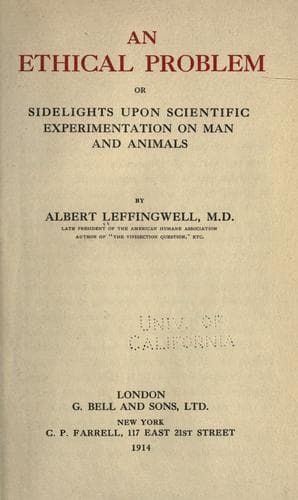
An ethical problem; or, Sidelights upon scientific experimentation on man and animalsLeffingwell, Albert
Philosophy
An ethical problem; or, Sidelights upon scientific experimentation on man and animals
Leffingwell, Albert
Medicine, Experimental; Vivisection
Take another instance. In the International Journal of Ethics for
April, 1904, there appeared an article in defence of animal
experimentation by Professor Charles S. Myers of the University of
Cambridge, England. Of any abuses of the practice, Dr. Myers gave his
readers no reason for believing that he had ever heard; and as an
indication, perhaps, of an animal's eagerness to be vivisected, he
tells us that "again and again dogs have been observed to wag the tail
and lick the hands of the operator even immediately before the
beginning of the operation." Commenting upon the singular conclusion
which this fact seemed to suggest to Dr. Myers, the present writer
quoted a sentence or two from an editorial which once appeared in the
columns of the London Lancet.[1] It would apparently seem that
Dr. Myers brought the quotation to the attention of someone in the
editorial office of the Lancet, on whose judgment he thought he might
safely rely; for, in a reply, he refers to it as a quotation
"attributed to the editor of the Lancet, which, AFTER SPECIAL INQUIRY,
I HAVE REASON FOR DOUBTING." Concerning a reference to some of
Dr. Sydney Ringer's experiments upon patients in a London hospital, he
is even more confident that they could never have occurred, and
indignantly rejoins, "I unhesitatingly declare SUCH ABOMINABLE
ACCUSATIONS TO BE FALSE."
[1] See p. 73 for this Lancet editorial.
Now, all this indignant scepticism was rather creditable to the
writer's heart. That an English medical journal like the Lancet
should denounce vivisection cruelties, or that a reputable London
physician should experiment on his patients with various poisons,
seemed to Dr. Myers beyond the bounds of belief. But it is always a
serious thing positively to deny any historical reference simply
because of personal ignorance of its truth. It was quite easy to
refer the sceptic not only to the editorial which he thought he "HAD
REASON FOR DOUBTING," but also to the experiments on human beings
concerning which his indignation rose so high. To be ignorant of
Dr. Ringer's experiments on his patients is to be ignorant of the
history of modern medicine. The Medical Times (London) in its issue
of November 10, 1883, thus editorially commented upon certain of these
experiments:
Public-domain text, read in full here on John Shaqi.
Reviews
Reviews
No reviews yet
Be the first to share your thoughts on this work.
Join the Discussion
Join the discussion
Sign in to leave a comment or review.
Sign InorCreate an account