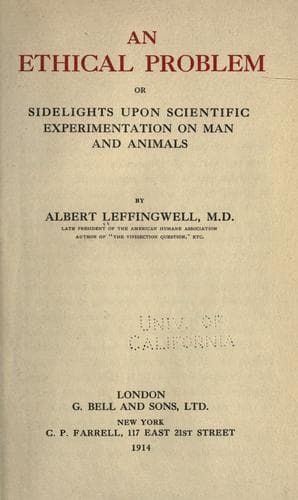
An ethical problem; or, Sidelights upon scientific experimentation on man and animalsLeffingwell, Albert
Philosophy
An ethical problem; or, Sidelights upon scientific experimentation on man and animals
Leffingwell, Albert
Medicine, Experimental; Vivisection
CHAPTER XVII
THE FUTURE OF VIVISECTION[1]
[1] Address delivered at Washington, D.C., before the International
Humane Congress, December 10, 1913.
Attempts to forecast the future development of Humanity in any
direction have always possessed for some minds a peculiar
fascination. Plato and Bacon had their visions of a State superior to
that in which they lived; Burton foresaw improvements in the
administration of justice, and the condition of the poorer classes,
which waited for two centuries for some measure of realization; even
Defoe had his list of "projects," some of which, laughed at in their
day, are the realities of our time. No great reform in any direction
was ever effected which had not been the unrealized vision of a
dreamer.
And such dreams are the romance of history. For any one to have
imagined two centuries ago, that the African slave-trade and negro
slavery would some day be condemned by every civilized nation, not
because they were pecuniarily unprofitable, but because they
contravened the conscience of Society and its sense of righteousness,
requierd a faith in the ultimate triumph of justice over greed, that
not one man in ten thousand possessed. For Calvin or Torquemada to
have imagined the coming of a time when the burning of an unbeliever
would not be regarded as pleasing to the Deity, demanded a sublimer
vision than either of them possessed. Custom and universal acceptance
would sometimes seem to create impregnable barriers against change.
But with the slow lapse of years, the venerated custom is attacked by
doubt; the superstition is undermined, and the great evil gradually
passes from the sight. No great wrong is so securely entrenched, as
to be absolutely safe from the ultimate condemnation of mankind.
What is to be the future of vivisection, as conducted in America to-
day? Is it to continue, without other limitations against cruelty than
those which are self-imposed, without legal restriction or restraint,
so long as civilization endures, ever widening its scope, ever
increasing the hecatombs of its victims, until uncounted milions shall
have been sacrificed? Is protest against excess to grow weaker, until
the ideal of humaneness in the laboratory shall become a scoff and a
byword? Is approval of any research in the name of Science to become
stronger until it shall cover the vivisection of human beings as well
as the exploitation of animals? Or are we to expect, as the result of
agitation, the legal suppression of all scientific research requiring
animal life, within the limits of the next half-century? It is easier
to ask questions than to answer them. Yet, as one who for over thirty
years, has taken some part in the agitation for reform, you may be
willing to permit a forecast of probabilities, vague, it may be, as
the vision of a sailor peering through the darkness that environs the
ship,--but the best he can do.
Public-domain text, read in full here on John Shaqi.
Reviews
Reviews
No reviews yet
Be the first to share your thoughts on this work.
Elsewhere in the archive
Join the Discussion
Join the discussion
Sign in to leave a comment or review.
Sign InorCreate an account