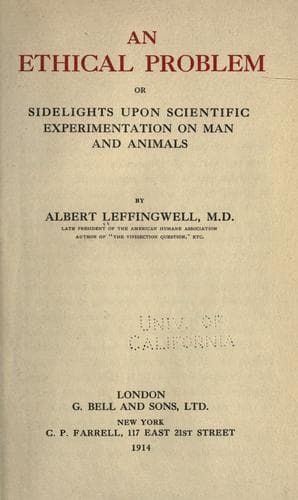
An ethical problem; or, Sidelights upon scientific experimentation on man and animalsLeffingwell, Albert
Philosophy
An ethical problem; or, Sidelights upon scientific experimentation on man and animals
Leffingwell, Albert
Medicine, Experimental; Vivisection
No estimate of the future of vivisection in America can be of value
which does not recognize the power of the laboratory at the present
day. Half a century ago, the vivisection of animals was rarely
practised; to-day, in the older states, there are few institutions of
higher learning which do not possess ample facilities for animal
experimentation. Millionaires, many times over, have been induced to
devote some part of their great wealth to the foundation and support
of institutions for exsperimentation upon living things. Farms have
been established where animals destined to sacrifice, are born and
bred. It may safely be estimated that in America, to-day, there are
not less than five hundred times as many experiments every year, as
took place half a century ago.
One must recognize, too, the change which has taken place in the
attitude of a majority of the medical profession towards this reform.
During the past thirty years, thousands of young men have entered the
profession, who have been carefully educated to regard all criticism
of animal experimentation as due to a sentimentalism worthy only of
contempt. I greatly doubt whether even one per cent. of the
physicians in America, under fifty years of age, have ever heard that
half a century ago, the feeling of the medical profession, in the
English-speaking world was almost unanimous in disapproval and
condemnation of methods and of experiments which now pass without
notice, and uncondemned. When men, educated to come into the closest
of relations with their fellow-beings, are thus prejudiced and
uninformed, should we wonder that their views are so widely accepted?
The wonder to me is rather that so large a minority are not to be
convinced that everything in a laboratory must be right.
Another element of the forces that to-day are marshalled against
reform, is the Press. Political journals, which even twenty-five
years ago endeavoured to hold an attitude of impartiality, now present
editorials almost every week in ridicule of any legal regulation of
vivisection, or of any opposition to laboratory freedom. The intimate
knowledge of medical matters sometimes exhibited by the writers, would
seem to indicate a closer relation between the physiological
laboratory of to-day, and the editorial sanctum, than existed forty
years ago. There are journals, so closely related, apparently, to
laboratory interests, that they do not permit correction of editorial
misstatements or mistake to appear in their columns, even when such
blunders are pointed out. The old impartial attitude of the Press
seems--except here and there--to have completely disappeared. Any
forecast of the future must take into account this vast and ever-
increasing influence.
Public-domain text, read in full here on John Shaqi.
Reviews
Reviews
No reviews yet
Be the first to share your thoughts on this work.
Elsewhere in the archive
Join the Discussion
Join the discussion
Sign in to leave a comment or review.
Sign InorCreate an account