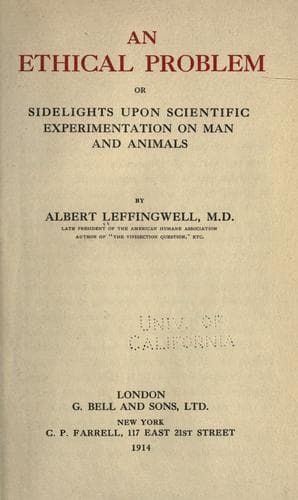
An ethical problem; or, Sidelights upon scientific experimentation on man and animalsLeffingwell, Albert
Philosophy
An ethical problem; or, Sidelights upon scientific experimentation on man and animals
Leffingwell, Albert
Medicine, Experimental; Vivisection
Yet another impediment to the legal repression of any cruelty
pertaining to animal experimentation is one which we all deplore, even
though no remedy appears in sight. It is not the opposition of
enemies, but division among friends that constitutes, in my opinion,
the greatest present obstacle to any reform. It is as though against
some strong fortress, different armies were engaging in an attack,
each with its separate purpose, its own plan of campaign, its own
ultimate aim, and now and then crossing and recrossing in each other's
way, to the infinite delight of the enemy. Some of us make the demand
that ALL such inquiry on the part of Science shall be made a crime;
and some of us take the position of the English-speaking medical
profession of forty years ago, that ABUSES AND CRUELTY ALONE should be
the object of attack. If opposition from the first, had been solely
directed against ABUSES of vivisection, could any reform have been
achieved? It is not certain. When Mr. Rockefeller opened his purse on
the vivisection table, he added immeasurably to the strength of the
forces that resist reform. And yet it is difficult to over-estimate
the loss to any cause of such men as Sir Benjamin Ward Richardson, as
Professor William James and Professor Henry J. Bigelow of Harvard
University, or of Dr. Theophilus Parvin of Jefferson Medical
College,--to refer only to the dead. Their criticisms of cruelty were
outspoken, but they could not join in universal condemnation of all
such inquiry into the phenomena of life. Might it not have been
better--even at the cost of a lessened demand--to have kept on the
side of reform that large element in the medical profession which
willingly condemned abuse, but declined to denounce the simplest
demonstration, or the most painless investigation? Of course such an
inquiry will receive different replies. It is ever the easier task to
make condemnation absolute. The thing has been done; the past is
beyond recall. But in looking at the future, we cannot but recognize
the changed attitude of a majority of the medical profession from that
of half a century ago.
Public-domain text, read in full here on John Shaqi.
Reviews
Reviews
No reviews yet
Be the first to share your thoughts on this work.
Elsewhere in the archive
Join the Discussion
Join the discussion
Sign in to leave a comment or review.
Sign InorCreate an account