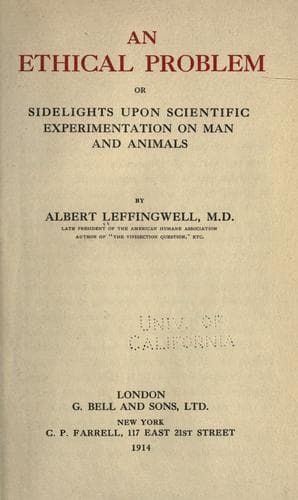
An ethical problem; or, Sidelights upon scientific experimentation on man and animalsLeffingwell, Albert
Philosophy
An ethical problem; or, Sidelights upon scientific experimentation on man and animals
Leffingwell, Albert
Medicine, Experimental; Vivisection
I. Any intelligently devised experiment upon an adult human being,
conscientiously performed by a responsible physician or surgeon solely
for the personal benefit of the individual upon whom it is made, and,
if practicable, with his consent, would seem to be legitimate and
right. In the practice of medicine, there must always be a "first
time" when a new method of medical treatment is tested, a new
operation performed, a new remedy employed. Whether the procedure
pertain to medicine or surgery, so long as the amelioration of the
patient is the one purpose kept in view, IT IS LEGITIMATE TREATMENT.
The motive determines the morality of the act.
II. Now human vivisection is something quite different. It has been
defined as "the practice of subjecting to experimentation human
beings--men, women, or children, usually inmates of public
institutions--by methods liable to involve pain, distress, injury to
health, or even danger to life, without any full, intelligent,
personal consent, FOR NO OBJECT RELATING TO THEIR INDIVIDUAL BENEFIT,
BUT FOR THE PROSECUTION OF SOME SCIENTIFIC INQUIRY."
The distinction is a perfectly clear one. Under the term "human
vivisection" only those experiments are included which have some of
these characteristics:
1. THE OBJECT IS SCIENTIFIC INVESTIGATION, AND NOT THE PERSONAL
WELFARE OR AMELIORATION OF THE INDIVIDUAL UPON WHOM THE EXPERIMENT IS
MADE.
2. The experiment is liable to cause some degree of pain, discomfort,
distress, or injury to the health, or danger to the life of the person
upon whom it is performed. The defence often made that no real injury
resulted from the experiment, cannot palliate the offence against
personal rights.
3. The experiment is performed without the intelligent, and full
consent of the individual experimented upon. Such legal consent of
course is impossible to obtain from children, from the feeble-minded,
or from lunatics in public institutions.
It is the purpose of this chapter to demonstratte that such
experiments upon human beings have been performed. Naturally, it will
be impossible to quote the cases in full. Enough, however, will be
given to prove that the charge of human experimentation is not the
exaggeration of ignorance or sentimentality; that such methods of
research have been practised upon the sick, the friendless, the poor
in public institutions, without their knowledge or intelligent
consent; that they are in vogue even in our own time; and that
hospitals and institutions, founded in many cases, for charitable
purposes, have lent their influence and aid in furnishing either
victims or experimenters.
Commenting upon certain human vivisections in Germany, the British
Medical Journal declared in its editorial columns:
Public-domain text, read in full here on John Shaqi.
Reviews
Reviews
No reviews yet
Be the first to share your thoughts on this work.
Elsewhere in the archive
Join the Discussion
Join the discussion
Sign in to leave a comment or review.
Sign InorCreate an account