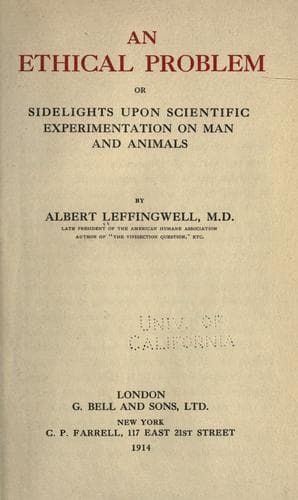
An ethical problem; or, Sidelights upon scientific experimentation on man and animalsLeffingwell, Albert
Philosophy
An ethical problem; or, Sidelights upon scientific experimentation on man and animals
Leffingwell, Albert
Medicine, Experimental; Vivisection
"Gross abuses in any profession should not be hushed up, but should
rather bemade public as freely as possible, so as to rouse public
opinion against them and thus render their repetition or spread
impossible. And therefore we have reason to thank the newspaper
Vorw"arts for dragging into light the experiments made by Dr. Strubell
on patients.... The whole medical profession must reprobate cruelties
such as these perpetrated in the name of Science."[1]
[1] British Medical Journal, July 7, 1900, p. 60.
It is this sentiment which justifies present publicity. The cases to
which attention will be directed are not many; but they suffice to
illustrate the practice, and to enable the reader to decide whether
such experiments should meet approval or condemnation.
I. The Case of Mary Rafferty
An instance of human vivisection which ended by the death of the
victim, occurred some years ago in the Good Samaritan Hospital in
Cincinnati. It would be difficult to suggest a name for a hospital
more suggestive of kindly consideration for the sick and unfortunate:
and to this charitable institution, there came one day a poor Irish
servant girl by the name of Mary Rafferty.
She was not strong, either mentally or physically. Some years before,
when a child, she had fallen into an open fire, and in some way had
severely burned her scalp. In the scar tissue an eroding ulcer--
possibly of the nature of cancer,--had appeared; and it had progressed
so far that the covering of the brain substance had been laid bare.
No cure could be expected; but with care and attention she might
possibly have lived for several months. We are told that she made no
complain of headache or dizziness; that she seemed "cheerful in
manner," and that "she smiled easily and frequently,"--doubtless with
the confidence of a child who without apprehension of evil, feels it
is among friends. The accident, however, had made her good
"material"; she offered opportunity for experimentation of a kind
hitherto made only upon animals. "It is obvious," says the
vivisector, "that it is exceedingly desirable to ascertain how far the
results of experiments on the brain of animals may be employed to
elucidate the functions of the human brain."[1]
[1] This case, under the significant title, "Experimental
Investigations into the Functions off the Human Brain," is related at
length in the American Journal of the Medical Sciences, vol. 93
(N.S., 67).
At the outset the experiments seem to have been somewhat cautiously
made. Nobody knew exactly what would be the result. The experimenter
began by inserting into Mary Rafferty's brain, thus exposed by
disease, needle electrodes of various lengths, and connecting them
with a battery. As a result, her arm was thrown out, the fingers
extended, but in the brain substance no pain was felt. Presently, as
the experimenter grew bolder, other phenomena appeared. The
vivisector shall tell the story in his own words:
Public-domain text, read in full here on John Shaqi.
Reviews
Reviews
No reviews yet
Be the first to share your thoughts on this work.
Elsewhere in the archive
Join the Discussion
Join the discussion
Sign in to leave a comment or review.
Sign InorCreate an account