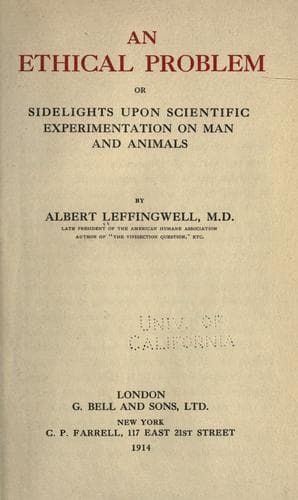
An ethical problem; or, Sidelights upon scientific experimentation on man and animalsLeffingwell, Albert
Philosophy
An ethical problem; or, Sidelights upon scientific experimentation on man and animals
Leffingwell, Albert
Medicine, Experimental; Vivisection
The inaccuracy which characterized this "statement of the whole truth"
was demonstrated at the time it appeared; but to one paragraph
attention may be recalled. The manifesto touches the question of past
cruelties in animal experimentation, not merely without the slightest
criticism or condemnation, but, on the contrary, with what would seem
to be a definite denial that anything reprehensible had ever
occurred. It contemptuously referred to evidence of abuses, as "these
reiterated charges of cruelty, THESE LONG LISTS OF ATROCITIES THAT
NEVER EXISTED." What other meaning could the average reader obtain
than the suggestion that the cruelties of Spallanzani, of Magendie, of
Mantegazza, of Brown-Se'quard, of Brachet, and a host of others,
existed only in the imagination, AND HAD NO BASIS OF FACT? For this
astounding suggestion, what explanation is possible? That there was a
deliberate purpose to mislead the public by an affirmation that cruel
and unjustifiable experiments were a myth, the creation of
imagination, is an hypothesis we must reject. But there must have
been a stupendous ignorance concerning the past history of animal
experimentation. Simply because of their utter lack of knowledge
regarding history, distinguished scientists became responsible for
suggesting to the public that the story of the past cruelty of
vivisection was a myth, and unworthy of belief.
While illustrations of this singular ignorance of the past might be
almost indefinitely multiplied, another example must for the present
suffice. It is afforded by the evidence given before the Royal
Commission of Vivisection in 1906, by Sir William Osler, M.D., Fellow
of the Royal Society, and Regius Professor of Medicine at the
University of Oxford. In the course of his examination, the following
dialogue occurred:[1]
"Are you familiar with the writings of Dr. Leffingwell?"
"Yes."
"I think he points out that it was through the strong attacks that
appeared in the Lancet and the British Medical Journal that the
Vivisection Act was passed?"
"THAT IS NEWS TO ME."
"You do not know that?"
"NO."
[1] Minutes of Evidence, Questions 16,780-16,782.
Public-domain text, read in full here on John Shaqi.
Reviews
Reviews
No reviews yet
Be the first to share your thoughts on this work.
Join the Discussion
Join the discussion
Sign in to leave a comment or review.
Sign InorCreate an account