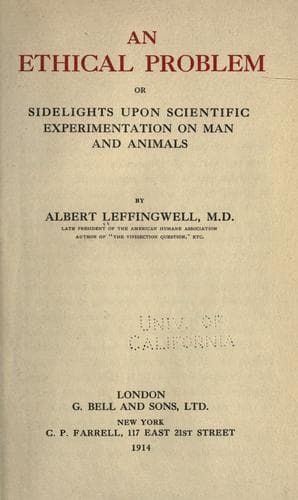
An ethical problem; or, Sidelights upon scientific experimentation on man and animalsLeffingwell, Albert
Philosophy
An ethical problem; or, Sidelights upon scientific experimentation on man and animals
Leffingwell, Albert
Medicine, Experimental; Vivisection
"The needle was now withdrawn from the left lobe, and passed in the
same way into the (brain) substance of the right. ... When the needle
entered the brain substance, SHE COMPLAINED OF ACUTE PAIN IN THE
NECK. IN ORDER TO DEVELOP MORE DECIDED REACTIONS, the strength of the
current was increased by drawing out the wooden cylinder one inch.
When communication was made with the needles, HER COUNTENANCE
EXHIBITED GREAT DISTRESS, and she began to cry. Very soon, the left
hand was extended as if in the act of taking hold of some object in
front of her; the arm presently was agitated with clonic spasms; her
eyes became fixed with pupils widely dilated; lips were blue, and SHE
FROTHED AT THE MOUTH; HER BREATHING BECAME STERTOROUS; SHE LOST
CONSCIOUSNESS AND WAS VIOLENTLY CONVULSED. The convulsion lasted five
minutes, and was succeeded by coma. She returned to consciousness in
twenty minutes from the beginning of the attack."
The experiment was a success. Upon the body of the poor servant girl,
the distinguished vivisector had produced the "violent epileptiform
convulsion" which Fritsch and Hitzig and Ferrier had induced in
animals, by the same method of experimentation.
There are those who feel that further vivisecting should have then
ceased, and that Mary Rafferty should have been allowed to die in
peace. Such views, however, were not permitted by the experimenter to
interfere with his zeal for scientific research. Other "observations"
were made, and the needles were again passed into the brain, evoking
almost the same phenomena. The final experiments were thus described
by the vivisector:[1]
"Two days subsequent to observation No. 4, Mary was brought into the
electrical room with the intention to subject the posterior lobes (of
the brain) to galvanic excitation. The proposed experiment was
abandoned. SHE WAS PALE AND DEPRESSED; HER LIPS WERE BLUE, AND SHE
HAD EVIDENT DIFFICULTY IN LOCOMOTION. She complained greatly of
numbness.... On further examination, there was found to be decided
PARESIS and rigidity of the muscles of the right side.... She became
very pale; her eyes closed; and she was about to pass into
unconsciousness, when we placed her in the recumbent posture, and
Dr. S. gave her, at my request, chloroform by inhalation.
"The day after observation No. 5, MARY WAS DECIDEDLY WORSE. She
remained in bed, was stupid and incoherent. In the evening she had a
convulsive seizure.... AFTER THIS, SHE LAPSED INTO PROFOUND
UNCONSCIOUSNESS, AND WAS FOUND TO BE COMPLETELY PARALYZED ON THE RIGHT
SIDE.... The pupils were dilated and motionless."
[1] Italics not in original.
When did death come to her release? We do not know; the omission is
significant; it may have been within a few moments. The next sentence
in the report is headed by the ominous word, "AUTOPSY." The brain was
taken out, and the track of the needles traced therein. One needle
had penetrated an inch and a half. There was evidence of "INTENSE
VASCULAR CONGESTION."
Public-domain text, read in full here on John Shaqi.
Reviews
Reviews
No reviews yet
Be the first to share your thoughts on this work.
Elsewhere in the archive
Join the Discussion
Join the discussion
Sign in to leave a comment or review.
Sign InorCreate an account