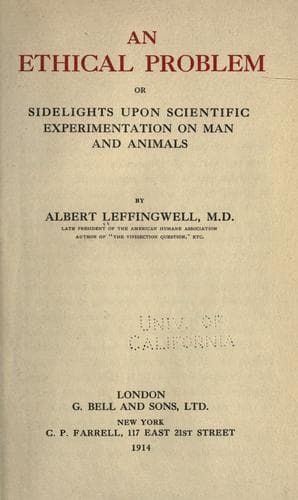
An ethical problem; or, Sidelights upon scientific experimentation on man and animalsLeffingwell, Albert
Philosophy
An ethical problem; or, Sidelights upon scientific experimentation on man and animals
Leffingwell, Albert
Medicine, Experimental; Vivisection
It might seem impossible that any physician of the present day would
care to come forward in defence of this experiment. Yet forty years
after the deed was perpetrated, such justification was apparently
attempted in an American journal, and republished in a pamphlet issued
by the American Medical Association.[1] It would seem at the outset
that only by suppression of the worst facts relating to the case,
could any defence be essayed. WAS THERE ANY SUCH SUPPRESSION OF
MATERIAL FACTS? Let us see.
[1] "The Charge of Human Vivisection," by Richard M. Pearce, M.D.,
Journal of the American Medical Association, February 28, 1914.
Did any injury to Mary Rafferty result from these experiments upon her
brain? Bartholow himself admits some injury; he says that to repeat
the experiments "would be in the highest degree criminal." The modern
apologist, however will have it otherwise. At the beginning of the
experiment, she smiled as if amused; and this, he tells us, "whows
that she did not object, that the pain was not severe, AND THAT NO
HARM WAS DONE HER." Is this a fair summary of the symptoms elicited
during these experiments upon the brain? Why did the apologist mention
only the "smile," and neglect altogether to mention the other symptoms
reported by Dr. Bartholow? Why does he pass in silence her complain of
"ACUTE PAIN IN THE NECK," the "GREAT DISTRESS" EXHIBITED, THE ARM
AGITATED WITH CLONIC SPASMS, THE FIXED EYES, THE WIDELY DILATED
PUPILS, THE BLUE LIPS, THE FROTHING AT THE MOUTH, THE STERTOROUS
BREATHING, THE VIOLENT CONVULSION lasting for five minutes and the
succeeding unconsciousness lasting for twenty minutes? Why does the
apologist leave unmentioned the symptoms following the subsequent
experiments,--the pallor and depression, the blue lips, the difficulty
in locomotion, the decided paresis and rigidity of muscles, the
profound unconsciousness, THE FINAL PARALYSIS? Do omissions like these
suggest an ardent desire to present the whole truth of the matter for
the information of the public?
The defender of the experiments tells us:
"It is not an uncommon procedure in neurologic surgery, to stimulate
after operation, in conscious patients, certain areas of the brain.
This procedure is a familiar one to all neurologists, and it is
THEREFORE DIFFICULT to understand why so much has been made of these
early observations in Cincinnati."[1]
[1] Italics not in original.
Aside from the astounding confession contained in this admission of
familiar procedure, it is difficult to understand what is meant by
this paragraph. Is it a suggestion that these experiments upon Mary
Rafferty were observations following a remedial surgical operation?
It is surely impossible that this can be the meaning; for in the
original account of the "Investigations into the function of the human
brain," there is not a line in support of such hypothesis. The reader
may make his own interpretation of a paragraph which seems exceedingly
obscure.
Public-domain text, read in full here on John Shaqi.
Reviews
Reviews
No reviews yet
Be the first to share your thoughts on this work.
Elsewhere in the archive
Join the Discussion
Join the discussion
Sign in to leave a comment or review.
Sign InorCreate an account