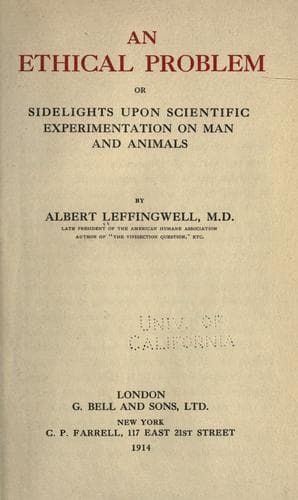
An ethical problem; or, Sidelights upon scientific experimentation on man and animalsLeffingwell, Albert
Philosophy
An ethical problem; or, Sidelights upon scientific experimentation on man and animals
Leffingwell, Albert
Medicine, Experimental; Vivisection
No apology for these experiments could be complete, which did not
refer to the alleged "consent." It is thus presented:
"If the patient under these circumstances consented to the
observations described, it would appear to be a matter between herself
and the physician making the observations."
This is the view of the matter which the apologist invites us to
accept. On the one side, stands a poor, ignorant, feeble-minded Irish
servant girl, full of faith and implicit trust in the benevolence of
those about her; on the other a learned scientist, eager, as he says,
"to ascertain how far the results of experiments on the brains of
animals may be employed to elucidate the functions of the human
brain"; and her "consent" to procedures the purpose and dangers of
which she knows nothing,--to experiments involving her life, are
suggested as a justification of whatever was done, and as a matter
with which Society need have no concern!
Upon such methods of vindication every intelligent reader may form his
own judgment. He will doubtless reach the conclusion that such vital
omission of essential facts,--no matter whether accidental or
intentional,--absolutely nullifies the value of the entire apology.
Let us hope that the next defender of these experiments, writing not
only for the instruction of the medical profession but also for the
general public, will proceed along somewhat different lines; that
every symptom which Bartholow mentions, he will mention also; that if
he speaks of the "CONSENT" of the victim, he will frankly tell us that
it was consent of one whom the experimenter himself called rather
"feeble-minded"; and that if he thinks other palliating circumstances
exist, he will at least graciously furnish us with references to the
evidence presented by the experimenter, upon which he grounds his
belief.
II. Experiments with Poison.
Of all experiments upon patients in hospitals, probably one of the
boldest was Dr. Sydney Ringer, physician to the University College
Hospital in London. His position in this institution gave him a
peculiarly favourable opportunity for the utilization of the human
"material" under his care. The experiments upon his patients were
frankly reported by himself, and were published in his well-known work
on Therapeutics.[1] For the most part these experiments were made with
poisonous drugs. Are we justified in classing them as human
vivisections? If in any case, the drug can be shown to have been
administered for the welfare of the patient, it was legitimate medical
treatment, to which criticism does not apply. Were the drugs so
administered? The experimenter shall describe his work in his own
language.
[1] "Handbook of Therapeutics," by Sydney Ringer, M.D. Eighth
edition, William Wood and Co., New York.
Poisoning with Salicine
Public-domain text, read in full here on John Shaqi.
Reviews
Reviews
No reviews yet
Be the first to share your thoughts on this work.
Elsewhere in the archive
Join the Discussion
Join the discussion
Sign in to leave a comment or review.
Sign InorCreate an account