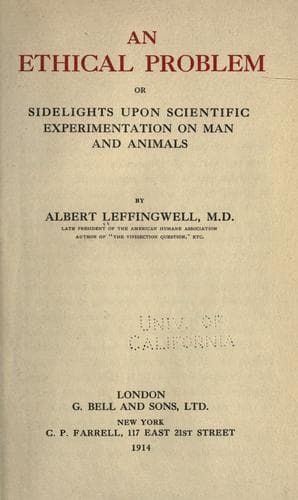
An ethical problem; or, Sidelights upon scientific experimentation on man and animalsLeffingwell, Albert
Philosophy
An ethical problem; or, Sidelights upon scientific experimentation on man and animals
Leffingwell, Albert
Medicine, Experimental; Vivisection
Many of the children were suffering from various ailments at the time
this test was made. Some had rickets, some typhoid fever, some
whooping-cough, pleurisy, pneumonia or heart disease. Some of them
were already near their end; in one case we are told that the "tests
were applied within eight days of death"; upon another emaciated
infant, the test was "applied three days before death." Infancy earned
no immunity from experimentation, for the eye-test was said to have
been applied "to seventeen infants, ranging in age from four weeks to
five months." In this group of cases, one infant was tested within the
last twenty-four hours of its pitiful and painful existence.
What were the possible consequences of these tests upon the sight of
the orphans and foundlings of St. Vincent's Home? The experimenters
frankly confess that at the outset they did not know.
"Before beginning application of the conjunctival test, WE HAD NO
KNOWLEDGE OF ANY SERIOUS RESULTS FROM ITS USE.... It has the great
disadvantage of producing a decidedly uncomfortable lesion, and it is
not infrequently followed by serious inflammations of the eye, which
not only produce great physical discomfort and require weeks of active
tratment, BUT WHICH MAY PERMANENTLY AFFECT THE VISION, AND EVEN LEAD
TO ITS COMPLETE DESTRUCTION.... W ehave had a number of verbal reports
of eye complications, some of them relating to very serious
conditions; and we are sure they are much commoner than the references
we have communicated would indicate.... In fact we are strongly of the
opinion that any diagnostic procedure which will so frequently result
in serious lesions of the eye has no justification in medicine...."
The conclusions concernng the occasionally disastrous consequences of
this eye-test were shortly confirmed by other experimenters. During
the following year, two Massachusetts physicians reported a study made
in "the out-patient clinic of the Carney Hospital and the
Massachusetts Chartiable Eye and Ear Infirmary," and they add: "We are
most indebted to the staff of the latter institution for allowing us
to make use of their material.... We have discarded the conjunctival
test, AS BEING OCCASIONALLY PRODUCTIVE OF DISASTROUS RESULTS."
In May, 1909, two Baltimore physicians reported their trials with two
forms of the tuberculin tests, "the result of over a year of
experience with patients coming to the Phipps Dispensary of the Johns
Hopkins Hospital." A year later they make an additional report.
"In May, 1909, we reported the results of the conjunctival and
cutaneous test in 500 patients. The present report deals with 1,000
additional patients to whom these tests were administered, and who
formed THE UNSELECTED MATERIAL OF AN AMBULANT CLINIC, the Phipps
Dispensary of the Johns Hopkins Hospital."
They, too, suggest the necessity for caution in making this
experiment. If a drop of the tuberculin, first in one eye and then in
the other, produced no reaction,
Public-domain text, read in full here on John Shaqi.
Reviews
Reviews
No reviews yet
Be the first to share your thoughts on this work.
Elsewhere in the archive
Join the Discussion
Join the discussion
Sign in to leave a comment or review.
Sign InorCreate an account