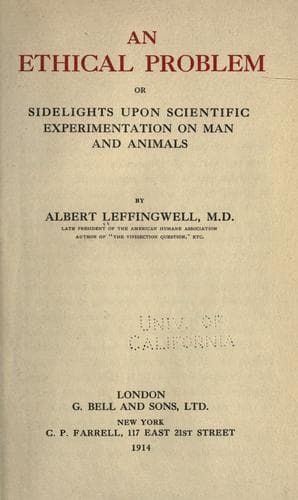
An ethical problem; or, Sidelights upon scientific experimentation on man and animalsLeffingwell, Albert
Philosophy
An ethical problem; or, Sidelights upon scientific experimentation on man and animals
Leffingwell, Albert
Medicine, Experimental; Vivisection
1. They were made indiscriminately upon large numbers of children or
adults, who were under treatment for various ailments.
2. They appear to have been purely experimental in character, and
without purpose of individual benefit.
3. They seem to have involved in some cases considerable discomfort or
pain and the risk of irreparable injury to the sight.
4. Dying children apparently were not exempt from experimentation.
A recent medical writer, defding the experiments, points out that the
tuberculin test could not convey the infection. The test, he says,
"depends on the principle that if a fluid in which tubercle bacilli
have grown, and which therefore contains the chemical products of
their growth is injected into an animal or person suffering from
tuberculosis, a transient increase of temperature occurs, and
constitutes the chief sign of a positive reaction.... Later it was
found that if the diluted tuberculin was placed on the surface of the
eye, there followed in tuberculous persons, a reddening or congestion
of the eye, which might go on to the stage of mild conjunctivitis."[1]
[1] Journal of the American Medical Association, February 28, 1914.
Is this a fair summary of the dangers of the eye-test? Let us see what
the experimenters tell us.
In the Archives of Internal Medicine for December 15, 1908, two
experimenters describe their work. When a drop of turberculin
solution is instilled into the eye of certain cases, there occurs,
they say, an infetion which varies in intensity in different
individuals, "usually attended by lachrimation and moderate fibrinous
or fibro-purulent exudation WHICH MAY GO ON TO PROFUSE SUPPURATION."
This "profuse suppuration" is something rather more severe than the
symptoms described by the apologist just quoted.
The experimenters say:
"Practically, all our patients were under eight years of age, and all
but twenty-sex of them were inmates of St. Vincent's Home, an
institution with a population of about four hundred, COMPOSED OF
FOUNDLINGS, ORPHANS, AND DESTITUTE CHILDREN. The cases in the Home
were tested in routine by wards, IRRESPECTIVE OF THE CONDITIONS FROM
WHICH THEY WERE SUFFERING, and in the great majority of instances
without any knowledge of their physical condition prior to, or at the
time that the tests were applied. We purposely deferred the physical
examination of these children until after the tests had been applied."
Would any medical practitioner, called to the house of a wealthy man
to examine his ailing child, purposely defer its physical examination
until after this eye-test had been applied?
Public-domain text, read in full here on John Shaqi.
Reviews
Reviews
No reviews yet
Be the first to share your thoughts on this work.
Elsewhere in the archive
Join the Discussion
Join the discussion
Sign in to leave a comment or review.
Sign InorCreate an account