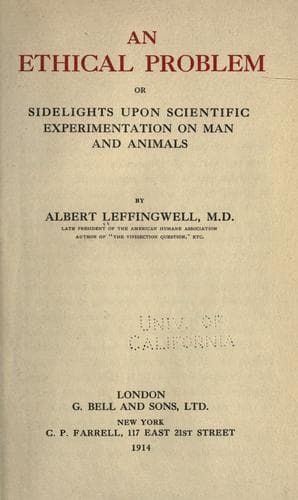
An ethical problem; or, Sidelights upon scientific experimentation on man and animalsLeffingwell, Albert
Philosophy
An ethical problem; or, Sidelights upon scientific experimentation on man and animals
Leffingwell, Albert
Medicine, Experimental; Vivisection
"We write these words not because we believe that any physician is so
far fallen below the lowest levels of our common humanity as to inject
into a defenceless child the active germs of a loathsome or possibly
fatal disease, but because our moral sense is outraged at any
treatment of the child such as we should refuse to permit were the
child our own. We believe he universal assertial of parents would be
that, if having taken their child to a hospital for tratment, they
learned that it had beenused for experimentation, though no lasting
harm could come to it from the experiment, someone would pay the
penalty for the unwarranted deed, if money or influence or, these
failing, muscle, could reach far enough to find the offender."
Does such condemnation of experimentation upon the hospital patient or
children tend to block scientific advance? Not at all. A recent
writer tells us that "once it is evident that man himself must be the
experimental animal, the scientist volunteer is always ready." If this
be so, why should not the human "material" be acquired always in a way
to which the charge of unjust procedure would never be applicable? If
assurance could have been given that the luetin test implied no risk
of any kind, might not the Rockefeller Institute have secured any
number of volunteers by the offer of a gratuity of twenty or thirty
dollars as a compensation for any discomfort that might be endured? Of
the thousands of medical students in the State of New York, are there
not hundreds who would have offered with eagerness to submit to a test
devoid of peril, in the interests of scientific research? And even if
an experiment implied danger, might there not be sufficient
compensation for all risks? Every year firemen lose their lives in the
flames, and policemen are murdered. The compensation they receive
induces them to incur risks that might not otherwise be assumed. A
great theologian is said to have affirmed that a man, perishing from
starvation, had the moral right to take a loaf of bread that did not
belong to him, if only thus he could preserve his life. Is Science
ever in such straits of necessity that in a single instance it is
obliged to take from any man his supreme right of inviolability, and
to make its experiments within the wards of the hospital, upon the
eyes of the dying, upon the bodies of the ignorant and the poor?
Public-domain text, read in full here on John Shaqi.
Reviews
Reviews
No reviews yet
Be the first to share your thoughts on this work.
Elsewhere in the archive
Join the Discussion
Join the discussion
Sign in to leave a comment or review.
Sign InorCreate an account