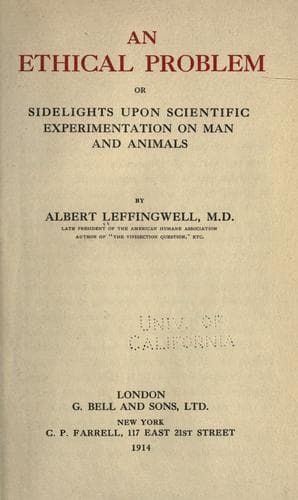
An ethical problem; or, Sidelights upon scientific experimentation on man and animalsLeffingwell, Albert
Philosophy
An ethical problem; or, Sidelights upon scientific experimentation on man and animals
Leffingwell, Albert
Medicine, Experimental; Vivisection
There is yet another method by which perhaps we may test the morality
of the practice. A great philosopher of another century seeking to
find some criterion of man's duty toward his fellow-men, based
obligation upon a universal law. "Act," said Kant, "as if the motive
of thy conduct were to become by thy will a universal law." Suppose we
apply this maxim of Kant to the use of human beings for research
purposes. An experimenter in a hospital makes dying children his
material. Is he willing that the maxim of his act should be
universal, and apply to experiments upon his own child, when it lies
at the point of death? He plunges needle-electrodes into the brain of
a simple-minded and perhaps friendless servant-girl. Can we imagine
him willing that the motive of his deed should govern and justify
experiments of the same kind made upon his mother or his wife?
Following Ringer, he tests the actions of poisons upon patients in
some hospital under his control. Would he be willing that the law be
universal, and that the action of such drugs should first be tested
upon himself? He suggests the use of healthy children as "controls" in
tests with the dead germs of a horrible disease. Is there anyone
connected with the Rockefeller Institute, for example, who would be
willing that such act should establish a universal precedent, and that
his own children should be taken, and without his knowledge, made the
"material" for such research?
Admitting that some experiments upon human being may be ethically
permissible, and that other phases of such investigations are morally
wrong, how are we to distinguish between them? May it not be possible
to indicate principles which would be generally accepted, according to
which the line may be drawn? Let us make the attempt.
I. Justifiable Experimentation upon Man
1. All experiments made by intelligent and conscientious physicians or
surgeons upon their patients for some definite purpose pertaining to
the personal benefit of the patient himself, and when practicable, in
case of risk, with his or her consent.
(This rule is intended to include every possible experiment made by a
medical practitioner for the benefit of the patient, with a distinct
ameliorative purpose in view.)
2. All experiments made with an intelligent purpose by a scientific
man or medical practitioner upon himself.
3. All experiments made with their consent upon physicians, surgeons,
pathologists, medical students or other scientific men, who, aware of
the nature of the investigation and of possible results, voluntarily
offer themselves as "material."
4. All experiments made upon men or women of ordinary intelligence
who, having been fully informed of the nature of the investigation and
of whatever distressing or dangerous consequences are obviously liable
to result, acknowledge the receipt of satisfactory compensation for
all risks, and give in writing their full and free consent.
Public-domain text, read in full here on John Shaqi.
Reviews
Reviews
No reviews yet
Be the first to share your thoughts on this work.
Elsewhere in the archive
Join the Discussion
Join the discussion
Sign in to leave a comment or review.
Sign InorCreate an account