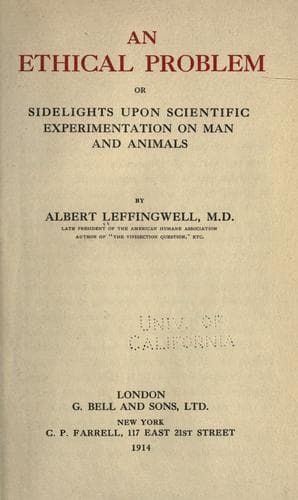
An ethical problem; or, Sidelights upon scientific experimentation on man and animalsLeffingwell, Albert
Philosophy
An ethical problem; or, Sidelights upon scientific experimentation on man and animals
Leffingwell, Albert
Medicine, Experimental; Vivisection
Suppose, then, that we look into this question. Was Professor
Bowditch correct in assigning the beginnings of criticism concerning
vivisection to Dr. Fleming's essay published in 1864? Or was its
origin long before? Were the professors of the Medical School accurate
of statement when they practically denied that cruelty in vivisection
was a historic fact, and endorsed a reference to authenticated
instances as "long lists of atrocities THAT NEVER OCCURRED"? Is it a
fact--although Dr. Myers of Cambridge and Sir William Osler of Oxford
apparently never heard of it--that it was the MEDICAL journals of
England whose indignant condemnation of vivisection cruelties led up
to its attempted regulation by law? The public assumes that
authorities like these are not likely to err concerning methods of
medical instruction or research. In the mind of the average man,
every prepossession is in their favour; he cannot easily bring himself
to believe that if cruelty ever existed, THEY should be so completely
ignorant of it. It may, indeed, be questioned whether in the
literature of controversy on the subject there has been a single
defender of unrestricted freedom in vivisection, who has intelligently
referred to the horrible experiments of past vivisectors except either
to sneer or to condone. Even Mr. Stephen Paget, in his recent work,
"Experiments upon Animals," never once condemned the cruelty that but
a generation ago excited indignation throughout the medical profession
of Great Britain.
The truth of this matter is not to be attained by unquestioning
acceptance of authority, but by a study of the history of the past.
It would be impossible, except in a volume, to write a complete
history of that protest against the unjustifiable cruelties of animal
experimentation, which gradually led to a demand for their legal
suppression. All that may here be attempted is a demonstration that
the sentiment is not of recent origin; that more than a century ago
the cruelties, which to-day are so carefully ignored, were
unquestioned as facts, and that to medical journals of England is
principally due that weighty condemnation of cruel vivisection, which
probably more than any other influence was the foundation of the
agitation for vivisection reform.
CHAPTER III
AN EIGHTEENTH-CENTURY VIVISECTOR
English literature during the eighteenth century presents no more
distinguished name than that of Dr. Samuel Johnson, the lexicographer
and essayist. His learning was immense; his judgments and criticisms
were everywhere regarded with respect; and, above other great men of
his time, he was fortunate in having as friend and companion one who
produced the best biography that the world has ever known.
Public-domain text, read in full here on John Shaqi.
Reviews
Reviews
No reviews yet
Be the first to share your thoughts on this work.
Join the Discussion
Join the discussion
Sign in to leave a comment or review.
Sign InorCreate an account