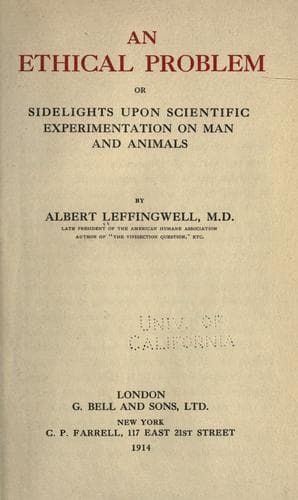
An ethical problem; or, Sidelights upon scientific experimentation on man and animalsLeffingwell, Albert
Philosophy
An ethical problem; or, Sidelights upon scientific experimentation on man and animals
Leffingwell, Albert
Medicine, Experimental; Vivisection
So terrible a confession of human vivisection, it was eemed best by
some English translator to suppress; and in various medical journals,
both in England and America, the sentence here italicized did not
appear. Finding it quoted only by the pamphlet that condemned human
vivisection, Dr. Keen, without consulting the original, made the
dishonouring imputation that perhaps it had been "DELIBERATELY ADDED"
by some one of his opponents, and this, too, notwithstanding he had
referred to the original authority where the words were to be
found. "Unfortunately," he explained at a later period, "I am not an
Italian scholar, and have never even seen Sanarelli's original
article"; he had placed dependence for his statement upon a
"friend."[1] Who could have been this "friend" who pretended that he
had read the article of Sanarelli in the original, and deceived him
into making a charge of forgery, for the truth of which there was not
a particle of foundation? But the thing of which his readers have a
right to complain is not that his "friend" deceived him, for that may
happen to anyone. It is this: that the imputation of forgery, the
untruth of which was admitted long ago, still remains in the essay
where it first appeared, and without there being the slightest
disclaimer of the false insinuation. Let the reader turn to p. 125 of
the work under review. There is the suggestion that Sanarelli's
allusion to the poisons fabricated in his laboratory may have been
"DELIBERATELY ADDED"--an imputation of forgery. WHERE ON THIS PAGE,
IN THE TEXT OR BY FOOTNOTE, HAS THE AUTHOR WITHDRAWN THAT INSINUATION?
IT CANNOT BE FOUND.
[1] "Animal Experimentation," pp. 143-144.
II.
One of the most serious offences against literacy accuracy which this
writer has apparently committed appears in the garbling of the
opinions of Dr. Henry J. Bigelow of Harvard University, on the subject
of vivisection. The case is of especial interest not only because the
facts are so clear, but because they bring into relief certain methods
of controversy, which by some seem to be regarded as entirely
justifiable.
A sketch of the life of Dr. Bigelow, with extended quotations from his
writings, will be found in the ninth chapter of the work now in the
reader's hands. The opinions there expressed regarding vivisection
are by no means extreme. No past writer on this subject has left
behind him more abundant evidence of his position in this
controversy. It was not animal experimentation that he condemned, but
the cruelty that sometimes accompanies it, and to which, if
vivisection be unregulated by law, it is so often liable.
Public-domain text, read in full here on John Shaqi.
Reviews
Reviews
No reviews yet
Be the first to share your thoughts on this work.
Elsewhere in the archive
Join the Discussion
Join the discussion
Sign in to leave a comment or review.
Sign InorCreate an account