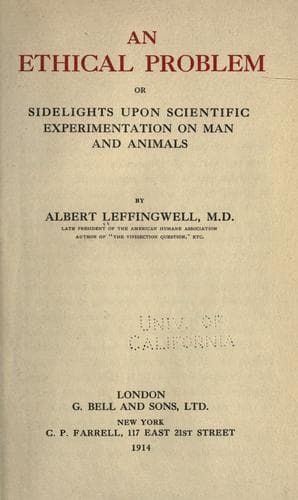
An ethical problem; or, Sidelights upon scientific experimentation on man and animalsLeffingwell, Albert
Philosophy
An ethical problem; or, Sidelights upon scientific experimentation on man and animals
Leffingwell, Albert
Medicine, Experimental; Vivisection
How may the views of such a writer be attacked after he is in his
grave? A physiological casuist would suggest, for instance, that
although for forty years connected with a medical school, Dr. Bigelow
really knew little or nothing about vivisection except what he had
chanced to see in France, although his writings abound with allusions
indicative of familiarity with laboratory scenes. It might be
asserted, indeed, that "in his later life," the great advocate of
reform had changed his views; and as a fair exposition of the new
attitude, a brief warning against confounding a painful with a
painless experiment would be quoted, after eliminating from the
paragraph anything that referred to cruelty or abuse.
Is not this exactly what the author of "Animal Experimentation" has
done in his attempt to discredit the weight of Dr. Bigelow's protests?
He tells his readers that "the opponents of research" quote the
Harvard professor's earliest utterances "based on the suffering he saw
at Alfort," but that they carefully omit this expression of his later
opinions:
"The dissection of an animal in a state of insensibility is no more to
be criticized than is the abrupt killing of it, to which no one
objects. The confounding of a painful vivisection and an experiment
which does not cause pain--either because the experiment itself is
painless, like those pertaining to the action of most drugs, or
because it is a trivial one and gives little suffering--has done great
damage to the cause of humanity and has placed the opponent of
vivisection at a great disadvantage.... A painless experiment on an
animal is unobjectionable."
This is all true enough. But can anyone call this paragraph a fair
statement of Dr. Bigelow's "later views" on animal experimentation? It
is merely a wise caution. Compare this brief quotation with the ninth
chaper of the book in the reader's hands. Will anyone, after reading
that chapter, maintain that THE THREE SENTENCES JUST CITED AFFORD A
FAIR SUMMARY OF THE DEAD SURGEON'S LATEST VIEWS?
The reader will note that in the passage just quoted from Bigelow,
something appears to have been omitted before the final sentence. On
turning to Dr. Bigelow's work, we find this sentence was eliminated
from the foregoing quotation.
"IF ALL EXPERIMENTS IN PHYSIOLOGY WERE AS PAINLESS AS THOSE IN
CHEMISTRY, THERE WOULD BE BUT ONE SIDE TO THE QUESTION."[1]
[1] Anaesthesia, by Henry J. Bigelow, M.D., p. 372.
Precisely! Then immediately following the words quoted by the author
of "Animal Experimentation," the reader will discover another most
significant passage which was suppressed by the author of "Animal
Experimentation":
Public-domain text, read in full here on John Shaqi.
Reviews
Reviews
No reviews yet
Be the first to share your thoughts on this work.
Elsewhere in the archive
Join the Discussion
Join the discussion
Sign in to leave a comment or review.
Sign InorCreate an account