An ethical problem; or, Sidelights upon scientific experimentation on man and animals — John Shaqi
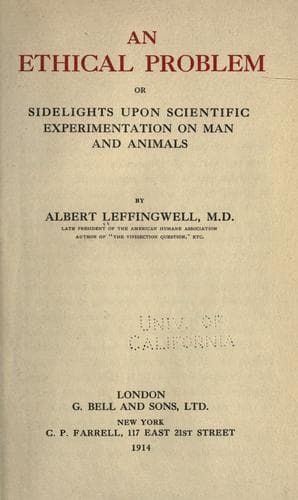
An ethical problem; or, Sidelights upon scientific experimentation on man and animalsLeffingwell, Albert
Philosophy
An ethical problem; or, Sidelights upon scientific experimentation on man and animals
Leffingwell, Albert
Medicine, Experimental; Vivisection
A more vigorous denunciation of the cruelty of vivisection never
appeared than these words of the first scholar of the English-
speaking world. Of course the plea will be put forth that in
Dr. Johnson's time the use of anaesthetics was unknown. Are we, then,
to conclude that the present-day defenders of absolute freedom in
animal research would join him in condemning the perpetrators of ALL
EXPERIMENTS CAUSING DISTRESS IN WHICH ANAESTHETICS CANNOT BE EMPLOYED?
For the merit of Dr. Johnson's plea lies in this, THAT HE MAKES
ETHICAL CONSIDERATIONS OF HIGHER IMPORTANCE THAN THE DISCOVERY OF
PHYSIOLOGICAL FACTS. "If the knowledge of physiology has been somewhat
increased, he surely buys knowledge dear who learns the use of the
lacteals at the expense of his own humanity." Is there a physiological
defenders of vivisection-freedom living to-day who would accept
Dr. Johnson's conclusion, that one should forbear research which is
possible only by the infliction of animal torment? How unfair it is,
therefore, to suggest that the force of Dr. Johnson's argument is
invalidated because anaesthetics were unknown--when the disagreement
is infinitely deeper!
To what physiologists of his time did Dr. Johnson allude? Apparently
his denunciation was sweeping; he referred to "a race of wretches"
rather than to any particular individual, and to experiments then
carried on and "published every day with ostentation." Who were the
men thus stigmatized? We do not know. The record of their useless
tormenting has sunk into the oblivion that hides their names; there
are but one or two whose identity may perhaps be guessed. It is
possible that one of them was John Hunter; yet Hunter did not go up to
London until 1764, and Dr. Johnson's condemnation had appeared three
years earlier. Still, this does not preclude the possibility that
Dr. Johnson had Hunter in his mind.
In some ways John Hunter was a remarkable man. He made an anatomical
collection, which is still in existence and which bears his name. At
Earl's Court, then a suburb of London, he established a sort of
zoological Inferno, that reminds one of the "Island of Dr. Moreau."
One of his biographers, Ottley, tells us that Hunger "TOOK SUPREME
DELIGHT" in his physiological experiments; and inasmuch as he
suggested in a letter to a friend the performance of the most
agonizing experiments as likely to "amuse" him, the statement was
undoubtedly true. A man's occupation generally has an influence upon
his character, and Hunter's biographer rather hesitatingly admits that
"he was not always very nice in his choice of associates," and that
among his companions were certain abominable wretches known as
"resurrection men," who robbed graveyards for the benefit of students
of anatomy. Under all circumstances, we can hardly be surprised that
his married life was anything but serene.
Public-domain text, read in full here on John Shaqi.
Reviews
Reviews
No reviews yet
Be the first to share your thoughts on this work.
Join the Discussion
Join the discussion
Sign in to leave a comment or review.
Sign InorCreate an account