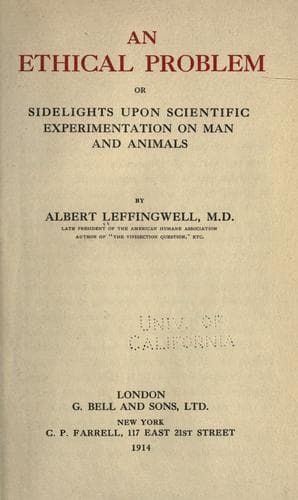
An ethical problem; or, Sidelights upon scientific experimentation on man and animalsLeffingwell, Albert
Philosophy
An ethical problem; or, Sidelights upon scientific experimentation on man and animals
Leffingwell, Albert
Medicine, Experimental; Vivisection
[1] Ottley's "Life of Hunter," p. 97.
Of other experiments by Hunter we know more. Sometimes his
observations were of a character that illustrates his environment. In
his "Observations" Hunter tells us that at one time, on going to bed
at night, he "observed bugs, marching down the curtains and head of
the bed; of those killed, NONE had blood in them." In the morning "I
have observed them marching back, and all such were found FULL OF
BLOOD!"[2] A wonderful discovery for a philosopher to record, leaving
unmentioned the one experiment and observation by which his fame is to
be linked with that of Harvey!
[2] Letter to Ottley, "Life," p. 89.
Hunter had erroneous views on various matters of science. He believed
that there was "no such thing as a primary colour, every colour being
a mixture of two, making a third." He tells us that he once formed a
theory that if a human being were completely frozen, "life might be
prolonged a thousand years, he might learn what had happened during
his frozen condition."[3] His biographer, Ottley, alludes to this
theory of Hunter's as "a project which, if realized, he expected would
make his fortune."[4] With this not altogether admirable object in
view, his experiments upon freezing animals were doubtless made. A
dormouse, confined in a cold mixture, he tells us, "showed signs of
great uneasiness; sometimes it would curl itself into round form to
preserve its extremities and confine the heat, and finding that
ineffectual, would then endeavor to escape." Its feet were at last
frozen, but Hunter could not freeze the entire animal because of the
protection afforded by the hair. How should the scientist overcome
this difficulty? He pondered over the problem; then made a dormouse
completely wet over, and placed it in the freezing-mixture. The
wretched animal "made repeated attempts to escape," but without avail,
and finally became quote stiff. Alas, for the grand "fortune"!
Hunter tells us that "on being thawed, it was found quite dead!"[1]
[3] "Lectures," i. 284.
[4] Ottley's "Life of Hunter," p. 57.
[1] Hunter's Works, vol. iv., p. 133.
The influence of Hunter upon English biology was undoubtedly very
great. In a mean and sordid society, he was an enthusiast for the
acquisition of knowledge, and while his passion for physiology
induced--as it so often does--an indifference regarding the infliction
of pain, his pitiless vivisections were not more cruel than
experiments made in this twentieth century, and some of them by men of
national reputation. He was the type of the class of experimenters
whom Dr. Johnson had in his mind, men whose long practice in the
infliction of torment creates an indifference to the ordinary emotions
of humanity, so that even in the causation of agony they find
something "to amuse," and in the performance of the most painful
vivisection an occasion for "supreme delight."
CHAPTER IV
MAGENDIE AND HIS CONTEMPORARIES
Public-domain text, read in full here on John Shaqi.
Reviews
Reviews
No reviews yet
Be the first to share your thoughts on this work.
Join the Discussion
Join the discussion
Sign in to leave a comment or review.
Sign InorCreate an account