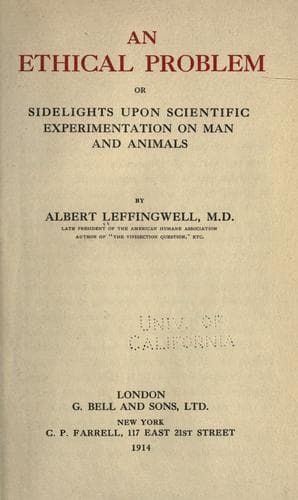
An ethical problem; or, Sidelights upon scientific experimentation on man and animalsLeffingwell, Albert
Philosophy
An ethical problem; or, Sidelights upon scientific experimentation on man and animals
Leffingwell, Albert
Medicine, Experimental; Vivisection
Abernethy, of Sir Everard Home (and of other distinguished medical
men), all uniting in condemnation of such excessive and protracted
cruelty as had been practised by this Frenchman."[1]
[1] Hansard's Parliamentary Reports, February 24, 1825.
Within the past forty years has the cruelty of Magendie been condemned
by any English or American physiologist? I have never seen it.
The objection is sometimes raised that evidence like this of
Magendie's cruelty is only "hearsay." Is not this generally the case
where inhumanity is concerned? When Wilberforce described the
atrocities of the African slave trade, or Shaftesbury the conditions
pertaining to children in coal-mines and cotton mills, their
statements were equally questioned; yet, when reform had been
accomplished, nobody doubted that, although they had not personally
witnessed the cruelties, they had reported only the facts. Now, one
peculiarity of Magendie's vivisections WAS THEIR PUBLICITY. There was
no attempt at concealment, such as governs the practice in England and
America to-day. Magendie's experiments were publicly made, seemingly
with a desire to parade his contempt for any sentiment of compassion
towards animals. The evidence of Magendie's cruelty is supported by
an overwhelming amount of evidence, and to Mr. Martin's account of his
vivisections, none of Magendie's English friends or apologists ever
ventured to reply in the public journals of the day.
An English physician, Dr. John Anthony, a pupil of Sir Charles Bell
and a strong advocate of vivisection, has given us a little account of
his personal experience in 1838, while a student of medicine in
Paris. The English members of his class, he says, "were indignant at
the CRUELTIES which we saw manifested IN THE DEMONSTRATION OF
EXPERIMENTS ON LIVING CREATURES.... What I saw in Paris pointed to
this: that very frequently men who are in the habit of making these
experiments are very careless of what becomes of the animal when it
has served its purpose; ... the animal is thrown (aside) to creep into
a corner and die.... I have carefully avoided seeing experiments in
vivisection after the awful dose which I had of it in Paris, in 1838.
THE MEN THERE SEEMED TO CARE NO MORE FOR THE PAIN OF THE CREATURE
BEING OPERATED UPON THAN IF IT WERE SO MUCH INORGANIC MATTER."[1]
[1] Vivisection Report, 1876, Questions 2,347, 2,447, 2,582.
Another witness of Magendie's cruelty was Dr. William Sharpey, LL.D.,
Fellow of the Royal Society, and for more than thirty years the
professor of physiology in University College, London. It is a
curious fact that the "Handbook of the Physiological Laboratory,"
which, when published in 1871, increased the agitation against
vivisection, was dedicated to Professor Sharpey. Before the Royal
Commission on Vivisection, in 1876, he gave the following account of
his personal experience:
Public-domain text, read in full here on John Shaqi.
Reviews
Reviews
No reviews yet
Be the first to share your thoughts on this work.
Join the Discussion
Join the discussion
Sign in to leave a comment or review.
Sign InorCreate an account