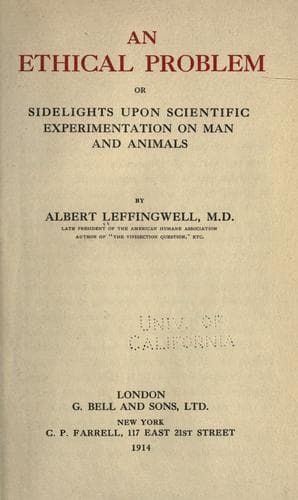
An ethical problem; or, Sidelights upon scientific experimentation on man and animalsLeffingwell, Albert
Philosophy
An ethical problem; or, Sidelights upon scientific experimentation on man and animals
Leffingwell, Albert
Medicine, Experimental; Vivisection
At every point in the discussion of vivisection we are confronted by
the plea of utility. If, to some extent, we may admit the
reasonableness of the argument, yet such admission must be with
certain definite reservations. The infliction of extreme pain either
upon human beings or on animals for objects other than their own
benefit--how far is it to be justified if some useful end is thereby
achieved? The subject is worth of study.
The utility of judicial torture as a method of securing the confession
of criminals does not seem to have been questioned for hundreds of
years. The Romans often put all their slaves to torture as soon as
any crime occurred, of which some of their servants could have been
aware. That sometimes the innocent suffered beyond endurance and
falsely confessed seemed to our forefathers no reason whatever for
changing an ancient custom, so often productive of useful ends.
Mysterious crimes, which under our modern methods of investigation
escape detection, were frequently brought to light in earlier times
simply by the threat of torment and the sight of the executioner.
There can be no question that in innumerable cases the torture of
accused criminals whose guilt was almost certain, yet not absolutely
proven, served to further the ends of Justice. If modern civilization
condemns the torture of suspected lawbreakers, it is upon other
grounds than that Justice finds it useless in every case.
The public punishment of great offences against the state--punishment
accompanied with ignominy and extreme torment--seemed to our ancestors
equally justified by utility. If an old woman were convicted of
witchcraft--and nobody questioned the actuality of the offence two
hundred and fifty years ago--her punishment by burning at the stake
certainly might be expected to deter others from entering into
compacts with the Evil One. If heresy and unbelief lead not only the
sceptic himself, but all who follow his teaching, into eternal
darkness, there seemed to our forefathers no surer method of checking
the first tendencies toward intellectual revolt, and saving
innumerable souls, than by delivering the heretic to the flames, and
accompanying his execution by everything calculated to excite popular
derision and execration. The public punishment of treason, and
particularly of attempted or achieved assassination of the sovereign
or head of the State, was made as excruciating and terrible as
possible, in order THAT THE EXAMPLE MIGHT DETER.
Public-domain text, read in full here on John Shaqi.
Reviews
Reviews
No reviews yet
Be the first to share your thoughts on this work.
Join the Discussion
Join the discussion
Sign in to leave a comment or review.
Sign InorCreate an account