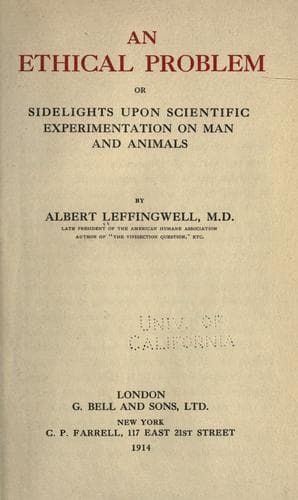
An ethical problem; or, Sidelights upon scientific experimentation on man and animalsLeffingwell, Albert
Philosophy
An ethical problem; or, Sidelights upon scientific experimentation on man and animals
Leffingwell, Albert
Medicine, Experimental; Vivisection
Toward three o'clock of the afternoon the same day, Damiens was
notified that everything was in readiness for his execution. Clothed
in but a single garment, he was made to mount a tumbril, and was
carried to the doors of the Cathedral of Notre Dame. Descending from
the cart, holding a lighted candle in his hands, he knelt and made
"l'amende honorable," after the form prescribed., It is but a short
distance from the Church of Notre Dame to the Place de Greve. Here a
vast crowd had gathered in order to witness the extremest agony of a
dying man. Members of the French aristocracy were present; ladies of
quality paid vast sums for the occupancy of windows overlooking the
square, and played cards to pass the time until the spectacle of
torment should begin. A scaffold about 9 feet square received the
executioners and their victim. The tortures were of the same
character as those inflicted in the same place upon the assassin of
Henry IV. There was the burning of the right hand, the mutilation of
the body and limbs, the pouring of melted lead and other substances
into bleeding wounds. Terrible cries, "heard at a great distance,"
were induced; there were shrieks for pity; there were prayers to God
for strength to endure: "Mon Dieu, la force! la force! Seigneur mon
Dieu, ayez pitie de moi! Seigneur mon Dieu, donnez-moi la patience!"
Prayers for patience, for strength to suffer and endure--these his
only petitions in the supreme agony.
At last came the final act of the tragedy. Four young and vigorous
horses were attached, each to a seared and lacerated limb, and the
attempt was made to rend asunder the still living body. The horrible
spectacle lasted for more than an hour. Finally the surgeon and the
physician in attendance gave it as their opinion that complete
dismemberment could not be effected except afer a partial severance of
the limbs. The operation was performed, the horses were again
attached, and the fearful spectacle came to an end. Damiens
apparently preserved consciousness even after both legs and an arm had
been torn from his body. The remains were gathered and burnt on the
place of torment, and the noble lords and ladies who had gloated over
the scene returned to their homes. It is not at all improbable that
among those who witnessed the torments of Damiens in 1757 for an
assault upon a King's sacred person there were some who lived to see
Louis XVI. mount the scaffold in 1793.[1]
[1] See "Pie`ces Originales des Process fait a Robert Franc,ois
Damiens, Paris," 1757, vol. iii., pp. 379-409; and Perkin's "France
under Louis XV.," vol. ii., p. 87.
Public-domain text, read in full here on John Shaqi.
Reviews
Reviews
No reviews yet
Be the first to share your thoughts on this work.
Join the Discussion
Join the discussion
Sign in to leave a comment or review.
Sign InorCreate an account