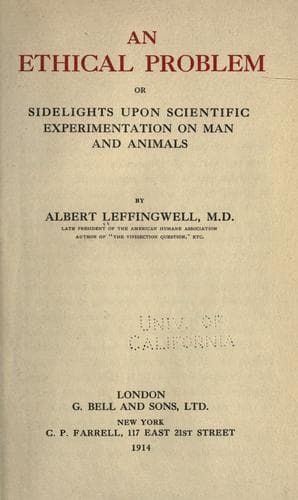
An ethical problem; or, Sidelights upon scientific experimentation on man and animalsLeffingwell, Albert
Philosophy
An ethical problem; or, Sidelights upon scientific experimentation on man and animals
Leffingwell, Albert
Medicine, Experimental; Vivisection
We shall perhaps be told that although the facts are as stated, yet
these medical condemnations of cruelty are the outgrown opinions of
the Past. Are the foundations of morals so unstable? Can lapse of
years transmute cruelty into benevolence and righteousness? Are we now
to be asked to approve the conduct of Magendie and of Mantegazza and
Be'rnard, and send to the lumber room of "past opinions" the
expressions of horror and repulsion which their acts once excited
throughout the English-speaking world? The science of the modern
school of physiologists gives that implication: "LET ALL THAT PASS,"
is their cry to-day. With this we cannot for a moment agree. Rather
let us believe that in the whirl and conflict of opinions that marks
the social evolution of Humanity, there are some principles which are
stable and some landmarks that cannot be altered. Cruelty is a vice
that should never be condoned. What was regarded as infamous in the
laboratory of fifty years ago should be considered equally infamous
to-day.
CHAPTER VIII
THE ATTAINMENT OF LEGAL REGULATION
The awakening of a nation to the existence of a great evil is only
accomplished after years of persistent agitation. We have seen that
some of the strongest denunciations of cruelty in biological
experimentation were due to that large element in the medical
profession which refused to condone cruelty under the guise of
utility. Gradually public opinion began to be thoroughly aroused. In
the year 1864 the Royal Society for the Prevention of Cruelty to
Animals offered a prize for the best essay on these questions:
"Is vivisection necessary or justifiable for purposes of giving
dexterity to the operator (as in veterinary schools)?
"Is it necessary or justifiable for the general purposes of science,
and, if so, under what limitations?"
The committee which decided the merits of the essays submitted
included some of the most distinguished scientists of England, among
them Professor Owen (better known as Sir Richard Owen), and Professor
Carpenter, physiologists of eminence and experience. The first prize
was accorded to Dr. George Fleming, the leading veterinary authority
in Great Britain for many years, and a second prize was given to
Dr. W. O. Markham, F.R.C.P., one of the physicians to St. Mary's
Hospital of London, and formerly lecturer on Physiology at St. Mary's
Hospital Medical School.
Dr. Fleming's essay was undoubtedly of great utility in calling
attention to the abuses pertaining to Continental physiological
teaching. That which makes his essay of chief value is not so much
the presentation of arguments, as the long array of unquestionable
facts for which the authorities are given. There is hardly a
physiological writer of distinction from whose works he did not quote
to illustrate the excesses he condemns.
Public-domain text, read in full here on John Shaqi.
Reviews
Reviews
No reviews yet
Be the first to share your thoughts on this work.
Elsewhere in the archive
Join the Discussion
Join the discussion
Sign in to leave a comment or review.
Sign InorCreate an account