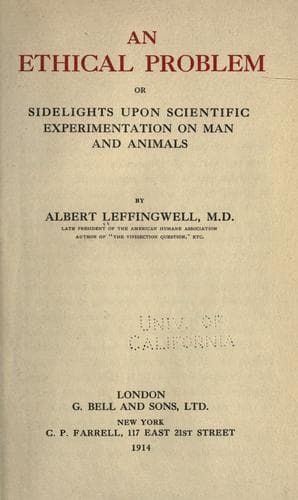
An ethical problem; or, Sidelights upon scientific experimentation on man and animalsLeffingwell, Albert
Philosophy
An ethical problem; or, Sidelights upon scientific experimentation on man and animals
Leffingwell, Albert
Medicine, Experimental; Vivisection
It is Dr. Markham's essay, however, which for us, at the present
moment, has principal significance. It is the argument of a
professional physiologist, defending the right of scientific research
within limits which then seemed just and right to the entire medical
profession of the United Kingdom. Every physiologist or physician
upon that committee which examined the essays is said to have marked
with approval this presentation of their views; and Professor Owen--
probably then the most distinguished man of science in Great Britain--
appended a note significant of his especial agreement. And yet
Dr. Markham's essay is never quoted at present by any advocate of free
vivisection; even Professor Bowditch in that address to which
reference has been made left unmentioned the work of his professional
brother, one of the earliest defenders of animal experimentation.
The reader of Dr. Markham's essay will not find it difficult to
comprehend the cause of this significant silence. Although the essay
was in no way sympathetic with antivivisection, it represented the
Anglo-Saxon ideal, in marked distinction from the doctrines which then
prevailed in the laboratories of Continental Europe, and which since
have become dominant throughout the United States. Defending the
practice of vivisection as a scientific method, Dr. Markham freely
admitted the prevalence of abuses to which it was liable when carried
on without regulation or restraint. Under proper limitations it was
at present necessary that some vivisection should be allowed; but with
the advance of knowledge, he believed that this necessity would
decrease, and the practice of animal experimentation gradually tend to
disappear. Some quotations from this essay will be of interest.
"The proper and only object of all justifiable experiments on animals
is to determine unknown facts in physiology, pathology, and
therapeutics, whereby medical science may be directly or indirectly
advanced. When, therefore, any fact of this kind has been once
determined and positively acquired to science, all repetition of
experiments for its further demonstration are unnecessary, and
therefore unjustifiable.
Public-domain text, read in full here on John Shaqi.
Reviews
Reviews
No reviews yet
Be the first to share your thoughts on this work.
Elsewhere in the archive
Join the Discussion
Join the discussion
Sign in to leave a comment or review.
Sign InorCreate an account