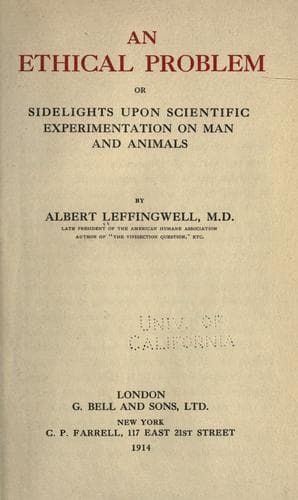
An ethical problem; or, Sidelights upon scientific experimentation on man and animalsLeffingwell, Albert
Philosophy
An ethical problem; or, Sidelights upon scientific experimentation on man and animals
Leffingwell, Albert
Medicine, Experimental; Vivisection
Some of his demonstrations were doubtless unproductive of pain, but in
view of the fact that in other experiments no anaesthetic was
employed, it may be questioned whether his second "rule" was always
very strictly observed. In one lecture he referred to his
demonstration "as the first time that we have applied electrical
stimulus to a nerve," and explains that when the experiment is made on
an animal paralyzed with curare, the effect is more complicated when a
sensory nerve is irritated, since then "the arteries all over the body
contract, because the brain is in action."[1] No plainer confession of
the existence of sensibility could be made, yet for obvious reasons
the lecturer carefully avoids admitting the presence of pain. During
the following year there appeared articles describing "the teaching of
practical physiology in the London schools." At King's College in
London, for example, demonstrations were made by the lecturer, but
"experiments on animals are never given to the ordinary student to do;
Professor Rutherford's experience on this point is that such attempts
result only in total failure."[2] On the other hand, at University
College, the Continental method of teaching was to be found. "Student
perform experiments on animals. Frogs, curarized or chloroformed, are
given them, and the experiment which has been fully explained and
demonstrated by the professor, is performed by them as far as
practicable."[3] Here, then, we find introduced into England (and
perhaps there existing in secret for some time before), that
vivisection of animals in illustration of well-known facts, which, but
a few years earlier, every leading medical journal of Great Britain
had so emphatically reprobated and denounced.
[1] Medical Times and Gazette, June 17, 1871.
[2] Ibid., July 20, 1872.
[3] Medical Times and Gazette, July 27, 1872.
The Continental school of English physiologists seemed confident of
victory. But the leading exponents of English ideals in medicine were
not inclined to surrender at once; now and then we find them
vigorously maintaining their ground, and disposed to contrast the
science gained in the laboratory with that gathered by experience and
fortified by reflection. Some extracts from a leading editorial in
the Medical Times and Gazette are extremely suggestive of the conflict
of opinions:
Public-domain text, read in full here on John Shaqi.
Reviews
Reviews
No reviews yet
Be the first to share your thoughts on this work.
Elsewhere in the archive
Join the Discussion
Join the discussion
Sign in to leave a comment or review.
Sign InorCreate an account