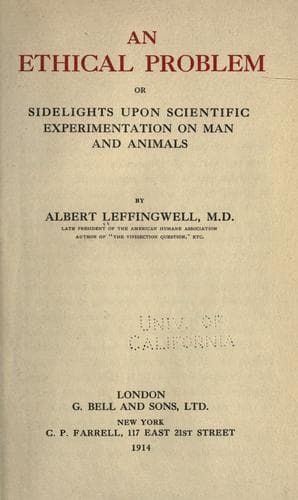
An ethical problem; or, Sidelights upon scientific experimentation on man and animalsLeffingwell, Albert
Philosophy
An ethical problem; or, Sidelights upon scientific experimentation on man and animals
Leffingwell, Albert
Medicine, Experimental; Vivisection
"The relation of physiology to practical medicine is a subject which
has been brought prominently into notice by the address of Dr. Burdon
Sanderson ... at the recent meeting of the British Association. That
address may be considered as the first authoritative and public
announcement made in this country that IT IS THE AIM AND INTENTION OF
THE PHYSIOLOGICAL SCHOOL OF THOUGHT and work to separate themselves
more and more from the school of practical medicine; no longer to
consider themselves auxiliary to it except as other sciences--for
instance, chemistry and botany--may be considered auxiliary to it, but
to win a place in the public estimation for their science as one which
shall be cultivated FOR ITS OWN SAKE...
"The teaching of experience is more reliable than physiological
theories and opinions.... The history of the advance of the cure of
disease is in the history of empiricism, in the best sense of that
much-abused word. The history of retrogression in the art of curing
disease is that of the so-called Physiological Schools of
Medicine... Physiological theory, based on experiments on dogs, wishes
us to believe that mercury does not excite a flow of bile; but here
the common sense of the Profession, educated by experience, has
refused to be led by physiological theory.... Modern physiological
science has taught us little more than the necessity of pure air,
water, and food, good clothing and shelter, moderation in eating and
drinking, and regulation of the passions--things, in fact, which are
as old as the Pentateuch. We may safely assert that all the
experiments made on luckless animals since the time of Magendie to the
present, in France, America, Germany, and England, have not prolonged
one tithe of human life, or diminished one tithe of the human
suffering that have been prolonged and diminished by the discovery and
use of Jesuits' bark and cod-liver oil."[1]
[1] Medical Times and Gazette (Editorial), September 7, 1872.
Public-domain text, read in full here on John Shaqi.
Reviews
Reviews
No reviews yet
Be the first to share your thoughts on this work.
Elsewhere in the archive
Join the Discussion
Join the discussion
Sign in to leave a comment or review.
Sign InorCreate an account