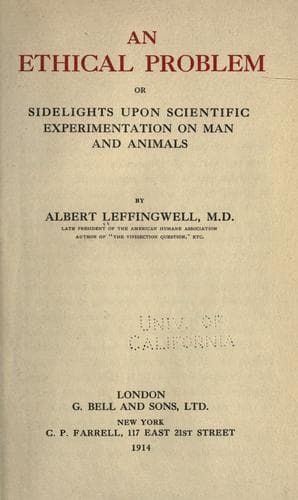
An ethical problem; or, Sidelights upon scientific experimentation on man and animalsLeffingwell, Albert
Philosophy
An ethical problem; or, Sidelights upon scientific experimentation on man and animals
Leffingwell, Albert
Medicine, Experimental; Vivisection
"On the other side, the discussion has been conducted as if it
concerned physiologists alone, who were to be a law unto themselves,
and each to do what might seem right in his own eyes; that the matter
was one into which outsiders had no right whatever to intrude; in
fact, that `WHATEVER IS, IS RIGHT,' and so unquestionably right as to
stand in no need of investigation or restriction. We have, from the
first, striven to take a middle course, not because it was safe, but
because it seemed to us the sound and true one. Without disguising
the difficulties, we have nevertheless expressed our conviction that
the subject was one about which it was impossible not to feel a sense
of responsibility, and a desire to ascertain whether the line between
necessary and unnecessary could be defined; and whether any attempt
could be made to institute something in the way of regulation,
supervision, or restriction, so as to secure that, while the ends of
science were not defeated, the broad principles of Humanity and duty to
the lower animals were observed. Animals have their rights every bit
as much as man has his...."
Admitting the probable necessity of some repetition of experiments in
research, the writer continues:
"It is for the purposes of instruction, however, that it becomes
questionable whether and to what extent experiments of this kind
should be performed. A chemical lecturer teaches well, in proportion
to the clearness with which he can demonstrate the correctness of his
statements by experiment, and there is no doubt it is the same with a
Lecturer on Physiology. Some persons seem to regard the advance of
knowledge as the whole duty of man, and they would perhaps consider
experimentation as justifiable in the one case as in the other. We
cannot so regard it, for the simple and sufficient reason (as it seems
to us) that the element of Life and Sensibility being present in the
one case and not in the other, carries a responsibility with it. We
contend that in any case where certain phenomena are known to follow a
given experiment, when the fact has been established by the separate
and independent observation of many different persons, a lecturer is
not justified in resorting to it FOR THE PURPOSE OF MERE DEMONSTRATION
WHERE ITS PERFORMANCE INVOLVES SUFFERING TO THE ANIMAL."[1]
[1] The London Lancet, February 6, 1875.
It is an instructive and interesting fact that one of the first steps
toward the legal regulation of vivisection in England was taken by
scientific men. The Lancet of May 8, 1875, contains the following
paragraph:
Public-domain text, read in full here on John Shaqi.
Reviews
Reviews
No reviews yet
Be the first to share your thoughts on this work.
Elsewhere in the archive
Join the Discussion
Join the discussion
Sign in to leave a comment or review.
Sign InorCreate an account