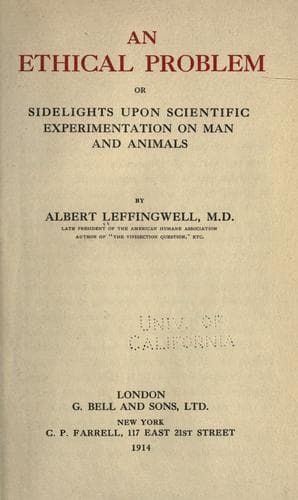
An ethical problem; or, Sidelights upon scientific experimentation on man and animalsLeffingwell, Albert
Philosophy
An ethical problem; or, Sidelights upon scientific experimentation on man and animals
Leffingwell, Albert
Medicine, Experimental; Vivisection
"Dr. Walker declared that his desire was not to stop scientific
research, but the abuses which were connected with it. In the first
place, he would not allow vivisection to be practised by incompetent
students. This was nothing but wanton and unrighteous cruelty.
THEREFORE HE WOULD OBLIGE EACH VIVISECTOR TO OBTAIN LEGAL PERMISSION
FROM COMPETENT AUTHORITY. Another abuse related to operations
performed merely to demonstrate physiological phenomena already
verified and established. Again, the number of animals vivisected was
shamefully high. Persons unacquainted with physiological laboratories
could form no idea of the lavish way in which animals were made to
suffer days and weeks of anguish and acute pain. If the people knew
of these sufferings, they would insist that the number of animals
annually vivisected should be limited, and that no animal rearing its
young should be experimented upon. Nor should it be allowable to
operate on an animal more than once.... Lastly, every licensed
vivisector should be obliged to send in an annual return, showing the
number of vivisections performed, and the scientific results attained,
which would prevent repeated operations with the same object. Nothing
in any of these proposals, urged Dr. Walker, would interfere with the
progress of science; they would simply stop the abuses which
existed."[1]
[1] Medical Times and Gazette (Editorial), June 27, 1874.
In January, 1875, we find the London Lancet also suggesting legal
supervision and restriction:
"We are utterly opposed to all repetition of experiments for the
purpose of demonstrating established doctrines.... We believe an
attempt might be made to institute something in the way of regulation
and supervision. IT WOULD NOT BE DIFFICULT, FOR EXAMPLE, TO IMPOSE
SUCH RESTRICTIONS ON THE PRACTICE OF THESE EXPERIMENTS as would
effectually guard against their being undertaken by any but skilled
persons, for adequate scientific objects."[2]
[2] The London Lancet (Editorial), January 2, 1875.
A month later the Lancet devotes its leading editorial to a discussion
of the ethics of vivisection. After criticizing the position taken
by the antivivisectionists, the writer says:
Public-domain text, read in full here on John Shaqi.
Reviews
Reviews
No reviews yet
Be the first to share your thoughts on this work.
Elsewhere in the archive
Join the Discussion
Join the discussion
Sign in to leave a comment or review.
Sign InorCreate an account