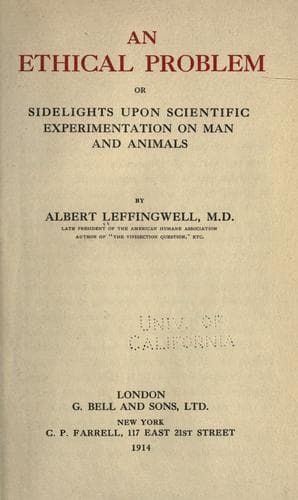
An ethical problem; or, Sidelights upon scientific experimentation on man and animalsLeffingwell, Albert
Philosophy
An ethical problem; or, Sidelights upon scientific experimentation on man and animals
Leffingwell, Albert
Medicine, Experimental; Vivisection
The Bill, though introduced in Parliament, was not pressed. Another
and more stringent measure for the regulation of vivisection had been
introduced a few days earlier through the efforts of Miss Frances
Power Cobbe and the Earl of Shaftesbury. In the conflict of opposing
statements and opinions, the Government wisely concluded that more
light on the subject was necessary, and a Royal Commission was
appointed to investigate and report.
But if the Continental party was to conquer in England, its members
undoubtedly felt that it must be through audacity quite as much by
silence and secrecy. At the annual meeting of the British Medical
Association, therefore, Professor William Rutherford delivered an
address, wherein for the second time an English physiologist openly
advocated the vivisection of animals as a method of teaching well-
known facts. Commenting upon this address, the editor of the Lancet
remarks:
"We confess that we think Dr. Rutherford presses his principle too far
when he argues that, teaching by demonstration being the most
successful method, we are thereby always warranted in having recourse
to it. Physiology and chemistry are both experimental sciences. The
chemical lecturer can have no hesitation in employing any number of
experiments, or repeating them indefinitely to illustrate every step
he takes; but we may fairly assume that the physiologist would be
restrained by the thought that the materials with which he has to deal
are not so much inert, lifeless matter, but sentient, living things.
We hold, therefore, that it would be both unnecessary and cruel to
demonstrate every physiological truth by experiment, or to repeat
indefinitely the same experiment, simply because by such
demonstrations the lecturer could make his teaching more definite,
precise, and valuable."[1]
[1] The London Lancet, (Editorial) August 21, 1875.
Again, somewhat later the same journal brings into prominence one of
the greatest difficulties attending all discussion of vivisection--the
lack of agreement upon the meaning of words:
"It is extremely difficult to get at the exact meaning of the terms
used. The physiologist would be ready to declare his utter abhorrence
of all `cruelty,' BUT THEN HE WOULD HAVE HIS OWN DEFINITION OF THE
WORD. We hope Sir William Thompson was not justified in stating that
revolting cruelties are sometimes practised in this country, in the
name of vivisection, although we may concur with him in reprehending
the performance of experiments on animals in illustration of truths
already ascertained.... When the Cardinal (Manning) laid it down as
the expression of a great moral obligation that we had no right to
inflict NEEDLESS pain, he begged the whole question. By all means lay
down and enforce any restriction that will prevent the infliction of
NEEDLESS pain."[1]
[1] The London Lancet (Editorial), March 25, 1876.
Public-domain text, read in full here on John Shaqi.
Reviews
Reviews
No reviews yet
Be the first to share your thoughts on this work.
Elsewhere in the archive
Join the Discussion
Join the discussion
Sign in to leave a comment or review.
Sign InorCreate an account