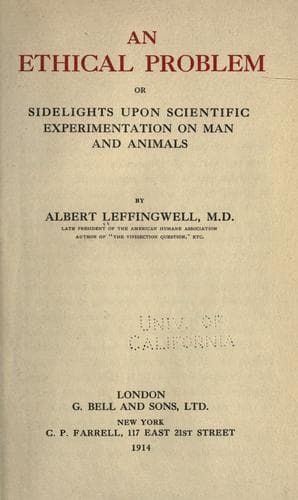
An ethical problem; or, Sidelights upon scientific experimentation on man and animalsLeffingwell, Albert
Philosophy
An ethical problem; or, Sidelights upon scientific experimentation on man and animals
Leffingwell, Albert
Medicine, Experimental; Vivisection
We see how valueless, therefore, is the assertion so frequently made
in this country that "no NEEDLESS pain is ever inflicted." The
physiologist has his own interpretation of the word.
The testimony given before the Royal Commission was of utmost value.
Leading members of the medical profession, such as Sir Thomas Watson,
physician to the Queen, and Sir William Fergusson, surgeon to the
Queen, gave evidence against the unrestricted practice of animal
experimentation. Physiologists after the Continental school stated
their side of the controversy, usually with significant caution; but
one of them, Dr. Emanuel Klein, with an honest frankness of confession
that astounded his friends, made himself for ever famous in the
history of the vivisection controversy. It is hardly accurate to say
that no cruelty was uncovered by the Royal Commission. Everything
depends on the meaning of words, but the evidence of one of the most
noted of English physiologists as to his own personal practices in
vivisection was quite sufficient to justify the legislation that
ensued. How seriously this evidence was regarded at the time is
clearly shown in an extract from a confidential letter of Professor
Huxley to Mr. Darwin, dated October 30, 1875:
"This Commission is playing the deuce with me. I have felt it my duty
to act as counsel for Science, and was well satisfied with the way
things are going. But on Thursday, when I was absent, --- was
examined; and if what I hear is a correct account of the evidence he
gave, I might as well throw up my brief. I am told he openly
professed the most entire indifference to animal suffering, and he
only gave anaesthetics to keep the animals quiet!
"I declare to you, I did not believe the man lived who was such an
unmitigated, cynical brute as to profess and act upon such principles,
and I would willingly agree to any law that would send him to the
treadmill.
"The impression his evidence made on Cardwell and Foster is profound,
and I am powerless (even if I desire, which I have not) to combat
it."[1]
[1] Huxley's "Life and Letters," vol i., p. 473. This
characterization seems by no means fair, and probably it would have
been so regarded by the writer in calmer moments. Is indignation
chiefly directed to the "indifference to animal suffering," or to the
"OPEN PROFESSION" of the feeling? For men, perfectly familiar with
Continental indifference, to condemn with holy horror a young
physiologist because he "openly professes" the generally prevalent
sentiment of his class, is very suggestive.
Public-domain text, read in full here on John Shaqi.
Reviews
Reviews
No reviews yet
Be the first to share your thoughts on this work.
Elsewhere in the archive
Join the Discussion
Join the discussion
Sign in to leave a comment or review.
Sign InorCreate an account