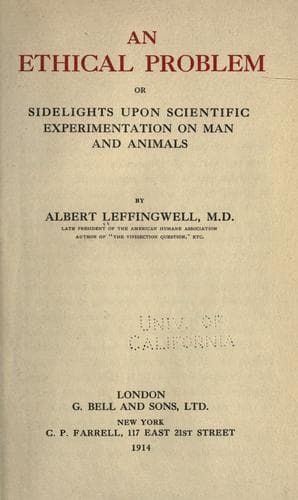
An ethical problem; or, Sidelights upon scientific experimentation on man and animalsLeffingwell, Albert
Philosophy
An ethical problem; or, Sidelights upon scientific experimentation on man and animals
Leffingwell, Albert
Medicine, Experimental; Vivisection
There can be no doubt, however, that the law has always been regarded
with marked disfavour by the extreme vivisectionists of Great
Britain. They had planned, as we can see, to introduce in the United
Kingdom the freedom of vivisection which obtained on the Continent.
They had failed, and instead of liberty to imitate Be'rnard, Magendie,
and Brown-Se'quard, they saw between them and the absolute power they
had craved and dreamed of obtaining, the majesty of English law.
Among American representatives of the same school--the strenuous
opponents of all legal supervision--it has been the fashion on every
possible occasion to cast discredit upon this Act. For obvious
reasons they have sought to represent it to the American public as
having proven a serious detriment to medical science and an
obstruction to medical advancement. The idea is absurd. English
physicians and surgeons are as well educated and equipped in every
respect as are the graduates of American schools. The complete
refutation of all such misstatements regarding the effect of the
English law will be found elsewhere. The Act is far from being an
ideal law--it is capable of amendment in many respects--but it is an
evidence of the acceptance by the English people of the principle of
State regulation, and of their wish that between the will of the
vivisector and the irresponsible and unlimited torment of the victim,
there hall be some power capable, if it so desires, of making
effective intervention.
CHAPTER IX
THE GREAT PROTESTANT AGAINST VIVISECTION CRUELTY
Among the critics of unlimited vivisection one American name of the
present century stands pre-eminently above all others, not only for
emphasis of denunciation, for vigour of condemnation, for clear
distinctions between right and wrong, but also for the distinguished
position which the writer held. Forty years ago in the medical
profession of the United States no name stood higher than that of
Dr. Henry J. Bigelow, the professor of surgery in Harvard University.
To estimate the value of his criticism it is necessary to outline his
career.
He was born in Boston, March 11, 1818, his father being Dr. Jacob
Bigelow, one of the leading physicians of his day. After completing
his medical education in America, young Bigelow went abroad, and spent
nearly three years studying in the great hospitals of Paris. It was
at a period when the cruel vivisections of Magendie and his
contemporaries had become the scandal of civilization, and there can
be no doubt that Dr. Bigelow witnessed every phase of vivisection that
his sensibilities permitted him to observe.
Public-domain text, read in full here on John Shaqi.
Reviews
Reviews
No reviews yet
Be the first to share your thoughts on this work.
Elsewhere in the archive
Join the Discussion
Join the discussion
Sign in to leave a comment or review.
Sign InorCreate an account