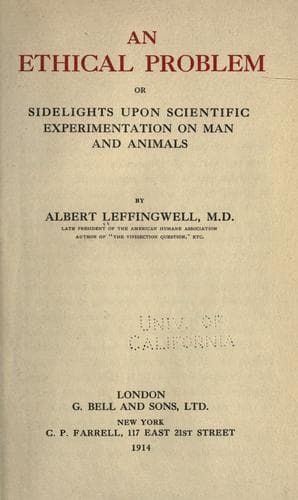
An ethical problem; or, Sidelights upon scientific experimentation on man and animalsLeffingwell, Albert
Philosophy
An ethical problem; or, Sidelights upon scientific experimentation on man and animals
Leffingwell, Albert
Medicine, Experimental; Vivisection
Returning to Boston in 1844, the young surgeon rapidly attained a
prominent position. In January, 1846, before he had completed his
twenty-eighth year, he was appointed visiting surgeon of the
Massachusetts General Hospital. Here on November 7, 1846, there
occurred one of the greatest historic events--the first surgical
operation in which insensibility to pain was secured by the inhalation
of ether. Dr. Bigelow's enthusiasm for the new discovery was very
great, and it has been said that to him "the world was indebted for
the introduction of anaesthesia in surgery at the exact time in which
it occurred."
Dr. Bigelow was surgeon to the Massachusetts General Hospital from
1846 to 1886--a period of forty years. He was professor of surgery in
Harvard University from 1849 to 1882, or a third of a century. When
he resigned the latter position, President Eliot in his annual report
referred to him as "a discoverer and inventor of world-wide
reputation, a brilliant surgical operator, a natural leader of men."
The faculty of Harvard Medical School also spoke of him as one "who
had done so much to render this school conspicuous and to make
American surgery illustrious throughout the world." This is high
praise. Let it be remembered in reading his opinions concerning
vivisection.
An abhorrence of pain was a marked trait in Dr. Bigelow's character.
Even to the infliction of necessary suffering he had an extreme
dislike. His gentleness to animals was akin to his tenderness for
children. He had a great respect for their intelligence, their
affection, their confidence in mankind. Toward the close of life he
had among his pets a number of the little animals most closely related
to human beings, and therefore the most-prized "material" of the
vivisector. But such was Dr. Bigelow's sympathy with his little
friends that he disliked to take visitors into their presence, and
when he did, always cautioned them to assume a smiling face. He was
unwilling to give his pets even the mental suffering of anxiety or
fear.
He died October 30, 1890, at the ripe age of seventy-two. It was
Dr. Oliver Wendell Holmes, himself illustrious in science and in
literature, who referred to the name of Dr. Henry J. Bigelow as "one
of the brightest in the annals of American surgery, not to claim for
it A STILL HIGHER PLACE IN THE HISTORY OF THE HEALING ART."
Public-domain text, read in full here on John Shaqi.
Reviews
Reviews
No reviews yet
Be the first to share your thoughts on this work.
Elsewhere in the archive
Join the Discussion
Join the discussion
Sign in to leave a comment or review.
Sign InorCreate an account