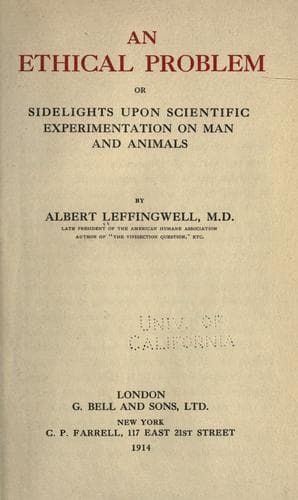
An ethical problem; or, Sidelights upon scientific experimentation on man and animalsLeffingwell, Albert
Philosophy
An ethical problem; or, Sidelights upon scientific experimentation on man and animals
Leffingwell, Albert
Medicine, Experimental; Vivisection
A definition of this kind will cover 99 per cent. of all experiments.
The extreme pro-vivisectionist may protest that the definition brings
into prominence the more painful operations; yet for the majority of
us the only ground for challenging the practice at all is the pain,
amounting to torment in some cases, which vivisection may involve.
They are rare, some one says. But how do we know? The doors of the
laboratory are closed. Of practices secretly carried on, what can we
know? That every form of imaginable torment has at some time been
practised in the name of Science, we may learn from the reports of
experimenters themselves, and from the writings of men who have
denounced them. It was Dr. Henry J. Bigelow, of Harvard University,
the most eminent surgeon of his day, who declared that vivisection
sometimes meant the infliction of "the severest conceivable pain, of
indefinite duration," and that it was "a torture of helpless animals,
more terrible, by reason of its refinement, than burning at the
stake." Is the above definition of vivisection stronger than is
implied by this assertion of Dr. Bigelow?
We need constantly to remember that vivisection is by no means a
simple act. It may indicate investigations that require no cutting
operation of any kind, and the infliction of no pain; or, on the other
hand, it may denote operations that involve complicated and severe
mutilations, and torments as prolonged and exquisite as human
imagination can conceive. Experiments may be made, in course of
researches, of very great interest and importance to medical science;
and, on the contrary, they may be performed merely to demonstrate
phenomena about which there is no doubt, or to impress on the memory of
a student some well-known fact. They may be performed by men like Sir
Charles Bell, who hesitated to confirm one of the greatest
physiological discoveries of the last century, merely because it would
imply a repetition of painful experiments; and they may be done by men
like Magendie, who declared of his mutilated and tormented victims,
that it was "DROLL to see them skip and jump about." It is because of
all these differences that the majority of men have an indefinite
conception of what they approve or condemn. The advocate of
unrestricted vivisection sometimes tells us that experimentation
implies no more pain than the prick of a pin, and that its results are
of great utility to the human race; the antivivisectionist, on the
other hand, may insist that such experimentation means inconceivable
torment without the slightest conceivable benefit to mankind. Both
are right in the occasional significance of the word. Both are wrong
if one meaning is to answer for all varieties of experimentation upon
living things.
Public-domain text, read in full here on John Shaqi.
Reviews
Reviews
No reviews yet
Be the first to share your thoughts on this work.
Join the Discussion
Join the discussion
Sign in to leave a comment or review.
Sign InorCreate an account