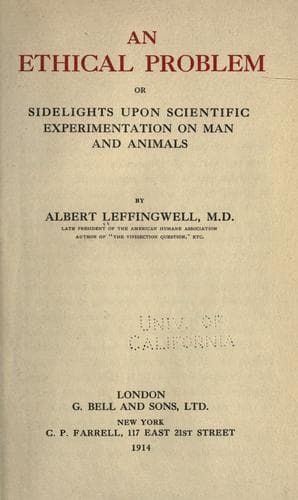
An ethical problem; or, Sidelights upon scientific experimentation on man and animalsLeffingwell, Albert
Philosophy
An ethical problem; or, Sidelights upon scientific experimentation on man and animals
Leffingwell, Albert
Medicine, Experimental; Vivisection
Such an outcome of the deliberations of the Royal Commission must have
seemed to American vivisectors almost a certainty. During the past
twenty years, repeated attempts have been made in New York, in
Massachusetts, in Pennsylvania, and in the city of Washington, to
obtain some legislation regulating the practice of animal
experimentation to the extent which obtains in England. At "hearings"
before various legislative and Senate Committees, all such attempts
have been vigorously combated by representatives and defenders of the
physiological laboratories, and their strongest argument has always
been the exceedingly detrimental effect of the English Act of 1876
both upon medical education and upon the progress of medical science.
Professor Bowditch once said:
"The amount of mischief which may be produced by the English law
depends very much on the good judgment of the Home Secretary.... In
general, it may be said that the system of licensing and Government
inspection is UNDER THE MOST FAVOURABLE CONDITIONS a source of serious
annoyance to investigation."
We shall have reason hereafter to see the inaccuracy of this
statement, so far as may be evinced by the opinions of English
physiologists and teachers.
Upon the secrecy now maintained in English laboratories, a vivid light
is thrown by the evidence given before the Commission. Quite as
strong as in America have been the precautions taken in England to
prevent any knowledge of the methods of vivisection from coming before
the general public except through the assertions of the experimenters
themselves. In America, where we have no legal limitations to
experimentation, such secrecy occasions no surprise; but that in
England the laboratory had secured so complete a degree of security
from criticism by concealment of that which we are told needs no
concealment gives reason for questionings. One of the Government
inspectors--a Dr. Thane--insists that although a physiological
laboratory is open to the visits of medical students at any time, it
would hardly be possible to permit a similar privilege to physicians
not in sympathy with experimentation. "I see no way of doing it," he
declares. He does not seem to be certain that one of the Royal
Commissioners before whom he was giving evidence could be admitted.
Dr. George Wilson asks him the question in regard to seeing the
various operations which are open to medical students. "I can go and
see them? I suppose I would have no difficulty?" Dr. Thane's reply was
by no means assuring. "I do not see how it could be done," he replied.
He could not see how one of the most distinguished physicians of
England could secure the legal right of admission to a physiological
laboratory!
Public-domain text, read in full here on John Shaqi.
Reviews
Reviews
No reviews yet
Be the first to share your thoughts on this work.
Elsewhere in the archive
Join the Discussion
Join the discussion
Sign in to leave a comment or review.
Sign InorCreate an account