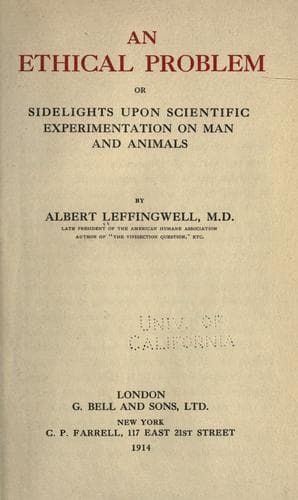
An ethical problem; or, Sidelights upon scientific experimentation on man and animalsLeffingwell, Albert
Philosophy
An ethical problem; or, Sidelights upon scientific experimentation on man and animals
Leffingwell, Albert
Medicine, Experimental; Vivisection
Some of the evidence given regarding this point seems a little
suggestive of a willingness to mislead a thoughtless questioner. Was
there any wish to give an impression that the secrecy of the
laboratory did not exist? One of the Government inspectors--Sir James
Russell--informed the Commissioners that HE never had any difficulty
in getting into laboratories. "I simply walk into them, and have
always found the doors open," as if that proved that there was nothing
to be concealed. The professor of physiology at University College
was particularly examined on this point. "Would there be any
difficulty in a doctor who was very strongly opposed on all grounds to
experiments on animals presenting his card and being present?" "None
whatsoever," was the Professor's answer to his questioner, the
Chairman of the Commission. "I want to see," added Lord Selby, "what
sort of check there is upon the neglect of the statute; ... whether
any medical man who disagreed with the Act and disagreed with
vivisection altogether would be able to attend?" "In these advanced
lectures there is no means by which we can prevent him from
attending," was the instant reply. "In point of fact, are ANY steps
taken with a view of preventing it?" "None whatever," was the reply.
"There is NOTHING to prevent it?" persisted Lord Selby; and the reply
of the professor was reiterated: "There is nothing to prevent the
attendance of any medical man at these advanced lectures."
The distinguished jurist undoubtedly believed that by these repeated
interrogations he had reached a complete denial of the secrecy of
experimentation so far as the witness was concerned.
On the day following, the same professor of physiology continued his
evidence, and another member of the Commission--A. J. Ram, Esq.--"one
of our counsel learned in the law," took part in the examination. "One
hears a good deal in lay papers and so forth about experiments
conducted with closed doors. IS THERE ANYTHING OF THAT SORT AT ALL?"
The very form of his inquiry would seem to indicate his disbelief in
the practice of secret vivisection. His question, however, admitted
of two different replies. The physiologist might assert the necessary
seclusion of physiological experimentation, or he might construe the
question in a literal sense as pertaining merely to the locking of his
inner door. He preferred the latter course. "I have ever come across
a laboratory where there were any closed doors. In my laboratory any
student wanting to speak to me walks straight in. The door of my
laboratory, where I do the chief part of my work, IS ALWAYS OPEN TO
THE PASSAGE."
Public-domain text, read in full here on John Shaqi.
Reviews
Reviews
No reviews yet
Be the first to share your thoughts on this work.
Elsewhere in the archive
Join the Discussion
Join the discussion
Sign in to leave a comment or review.
Sign InorCreate an account