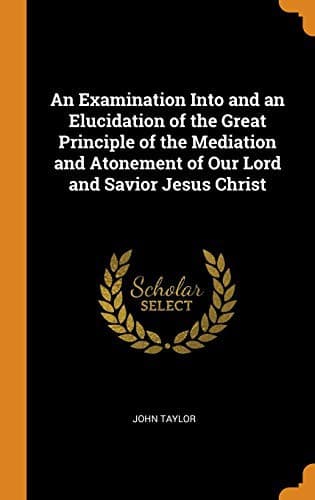
An Examination into and an Elucidation of the Great Principle of the Mediation and Atonement of Our Lord and Savior Jesus Christ — John Shaqi
An Examination into and an Elucidation of the Great Principle of the Mediation and Atonement of Our Lord and Savior Jesus ChristTaylor, John
Religion
An Examination into and an Elucidation of the Great Principle of the Mediation and Atonement of Our Lord and Savior Jesus Christ
Taylor, John
Atonement -- Mormon Church; Latter Day Saint churches -- Doctrines
There is a principle developed here pertaining to the economy of God
with the human family. Abel held a representative position, as also
did Cain, and that position, it would seem, associated Abel with what
may be denominated the chosen seed. Cain slew Abel; but (that, the
purposes relating to the perpetuation of that seed might stand, and
the plan of God not be frustrated by the adversary, He gave to Adam
Seth, who inherited the priesthood and promises of his martyred
brother; in this substantiating a principle that Paul refers to, when
he writes, "That the purpose of God, according to election, might
stand, not of works, but of him that calleth." [Rom., ix, 11.] Yet,
although Seth was one of the leading characters spoken of in the
Scripture, and one to whom and through whom the promises were made,
and who actually stood in the place of or represented his brother,
Abel, yet there is nothing said in the ordinary translation pertaining
to his offering sacrifices; we therefore again refer to the Pearl of
Great Price. It is there stated that "Adam glorified the name of God,
for he said, God hath appointed me another seed instead of Abel, whom
Cain slew. And God revealed himself unto Seth, and he rebelled not,
but offered an acceptable sacrifice like unto his brother Abel."
Seth, we are here told, rebelled not, but offered an acceptable
sacrifice, thus carrying out the same idea of the atonement of the
Only Begotten. In this connection we must remember that there had been
a rebellion in heaven, and many of the angels, they "which kept not
their first estate," [Jude, 6,] were cast out. Lucifer was the leader
of these rebellious ones who were then cast down to the earth. He had
rebelled against God, his Father, and it would seem, from revelations
that we shall hereafter draw attention to, that his rebellion had its
origin in his rejection of the counsel given to him by his Father
pertaining to the salvation and exaltation of mankind. When man was
placed upon the earth, Lucifer, or Satan, still manifested the same
animus and spirit; and through his influence he operated upon Cain,
for Cain listened to his wiles, and being controlled by him, he also
rebelled against his father and his God. Thus the rebellion in the
heavens was transmitted to a rebellion on the earth, and all who
became subject to this influence placed themselves in a state of
enmity and antagonism to God, and one of the first results exhibited
was covetousness and murder, even the murder by Cain of his brother
Abel. Thus we find the first man slain (Abel) was one holding the holy
Priesthood, and the same vindictive spirit manifested against the
servants of God of all later ages, gave the martyr Stephen good reason
to ask his persecutors,
"Which of the prophets have not your fathers persecuted? and they have
slain them which showed before of the coming of the Just One; of whom
ye have been now the betrayers and murderers."--Acts, vii, 52.
Public-domain text, read in full here on John Shaqi.
Reviews
Reviews
No reviews yet
Be the first to share your thoughts on this work.
Join the Discussion
Join the discussion
Sign in to leave a comment or review.
Sign InorCreate an account