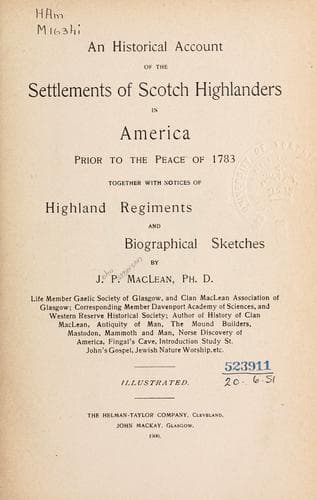
An Historical Account of the Settlements of Scotch Highlanders in AmericaMacLean, J. P. (John Patterson)
History
An Historical Account of the Settlements of Scotch Highlanders in America
MacLean, J. P. (John Patterson)
Scots -- America; Scots -- United States
This request we have already laid before Congress who are willing to
grant it, provided they shall have your approbation.
Hoping therefore, that you have no particular intention to distress
us more than others whom you have treated with Indulgence, we flatter
ourselves that your determinations will prove no obstruction to our
Enlargement on the above terms; and have transmitted to you the
enclosed Copy of the Resolve of Congress in our favor, which if you
countenance; it will meet with the warmest acknowledgement of Gentn.
Your most obedt. humble Servts.,
Alexander Morison, Ferqd. Campbell, Alexr. Macleod,
Alexr. McKay, James Macdonald, John McDonald, Murdoch
Macleod, John Murchison, John Bethune, Neill McArthur, John
Smith, Murdo MacCaskill, John McLeod, Alexr. McDonald, Angus
McDonald, John Ligett."[71]
It was fully apparent to the Americans that so long as the leaders were
prisoners there was no danger of another uprising among the Highlanders.
This was fully tested by earl Cornwallis, who, after the battle of
Guilford Courthouse, retreated towards the seaboard, stopping on the way
at Cross Creek[72] hoping then to gain recruits from the Highlanders,
but very few of whom responded to his call. In a letter addressed to Sir
Henry Clinton, dated from his camp near Wilmington, April 10, 1781, he
says:
"On my arrival there (Cross Creek), I found, to my great
mortification, and contrary to all former accounts, that it was
impossible to procure any considerable quantity of provisions, and
that there was not four days' forage within twenty miles. The
navigation of Cape Fear, with the hopes of which I had been flattered
was totally impracticable, the distance from Wilmington by water
being one hundred and fifty miles, the breadth of the river seldom
exceeding one hundred yards, the banks generally high, and the
inhabitants on each side almost universally hostile. Under these
circumstances I determined to move immediately to Wilmington. By this
measure the Highlanders have not had so much time as the people of
the upper country, to prove the sincerity of their former professions
of friendship. But, though appearances are rather more favorable
among them, I confess they are not equal to my expectations."[73]
The Americans did not rest matters simply by confining the officers, but
every precaution was taken to overawe them, not only by their parole,
which nearly all implicitly obeyed, but also by armed force, for some
militia was at once stationed at Cross Creek, which remained there until
the Provincial Congress, on November 21, 1776, ordered it
discharged.[74] General Charles Lee, who had taken charge of the
Southern Department, on June 6, 1776, ordered Brigadier-General Lewis to
take "as large a body of the regulars as can possibly be spared to march
to Cross Creek, in North Carolina."[75]
Public-domain text, read in full here on John Shaqi.
Reviews
Reviews
No reviews yet
Be the first to share your thoughts on this work.
Elsewhere in the archive
Join the Discussion
Join the discussion
Sign in to leave a comment or review.
Sign InorCreate an account