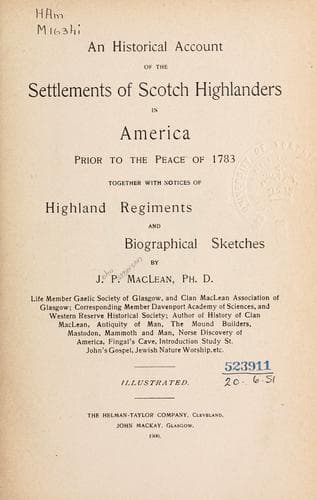
An Historical Account of the Settlements of Scotch Highlanders in AmericaMacLean, J. P. (John Patterson)
History
An Historical Account of the Settlements of Scotch Highlanders in America
MacLean, J. P. (John Patterson)
Scots -- America; Scots -- United States
Notwithstanding the fact that many of the Highlanders who had been in
the battle of Moore's Creek Bridge afterwards engaged in the service
with the Americans, the community was regarded with suspicion, and that
not without some cause. On July 28, 1777, it was reported that there
were movements among the royalists that caused the patriots to be in
arms and watch the Highlanders at Cross Creek. On August 3rd it was
again reported that there were a hundred in arms with others coming.[76]
As might be anticipated the poor Highlanders also were subjected to fear
and oppression. They remained at heart, true to their first love. In
June, 1776, a report was circulated among them that a company of light
horse was coming into the settlement, and every one thought he was the
man wanted, and hence all hurried to the swamps and other fastnesses in
the forest.[77]
From the poor Highland women, who had lost father, husband, brother in
battle, or whose menfolk were imprisoned in the gaol at Halifax, there
arose such a wail of distress as to call forth the attention of the
Provincial Congress, which at once put forth a proclamation, and ordered
it translated into the "Erse tongue," in which it was declared that they
"warred not with those helpless females, but sympathized with them in
their sorrow," and recommended them to the compassion of all, and to the
"bounty of those who had aught to spare from their necessities."
One of the remarkable things, and one which cannot be accounted for, is,
that although the North Carolina Highland emigrants were deeply
religious, yet no clergyman accompanied them to the shores of America,
until 1770, when Reverend John McLeod came direct from Scotland and
ministered to them for some time; and they were entirely without a
minister prior to 1757, when Reverend James Campbell commenced to preach
for them, and continued in active work until 1770. He was the first
ordained minister who took up his abode among the Presbyterian
settlements in North Carolina. He pursued his labors among the
outspreading neighborhoods in what are now Cumberland and Robeson
counties. This worthy man was born in Campbelton, on the peninsula of
Kintyre, in Argyleshire, Scotland. Of his early history but little is
known, and by far too little of his pioneer labors has been preserved.
About the year 1730 he emigrated to America, landing at Philadelphia.
His attention having been turned to his countrymen on the Cape Fear, he
removed to North Carolina, and took up his residence on the left bank of
the above river, a few miles north of Cross Creek. He died in 1781. His
preaching was in harmony with the tenets of his people, being
presbyterian. He had three regular congregations on the Sabbath, besides
irregular preaching, as occasion demanded. For some ten years he
preached on the southwest side of the river at a place called "Roger's
meeting-house." Here Hector McNeill ("Bluff Hector") and Alexander
McAlister acted as elders.
Public-domain text, read in full here on John Shaqi.
Reviews
Reviews
No reviews yet
Be the first to share your thoughts on this work.
Elsewhere in the archive
Join the Discussion
Join the discussion
Sign in to leave a comment or review.
Sign InorCreate an account