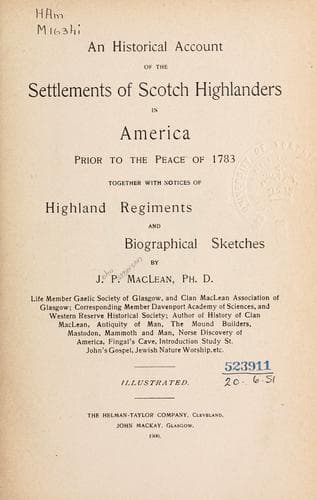
An Historical Account of the Settlements of Scotch Highlanders in AmericaMacLean, J. P. (John Patterson)
History
An Historical Account of the Settlements of Scotch Highlanders in America
MacLean, J. P. (John Patterson)
Scots -- America; Scots -- United States
On their first landing at Savannah, some of the people from South
Carolina endeavored to discourage them by saying that the Spaniards
would shoot them as they stood upon the ground where they contemplated
erecting their homes. "Why then," said the Highlanders in reply, "we
will beat them out of their fort and shall have houses ready built to
live in." The spot designated for their town is located twenty miles
northwest from St. Simons and ten above Frederica, and situated on the
mainland, close to a branch of the Alatamaha river, on a bluff twenty
feet high, then surrounded on all sides with woods. The soil is a
brackish sand. Formerly Fort King George, garrisoned by an independent
company, stood within a mile and a half of the new town, but had been
abandoned and destroyed on account of a want of supplies and
communication with Carolina. The village was called New Inverness, in
honor of the city they had left in Scotland; while the surrounding
district was named Darien, on account of the settlement attempted on the
Isthmus of Darien, in 1698-1701. Under the direction of Hugh MacKay, who
proved himself to be an excellent officer and a man of executive
ability, by the middle of February they had constructed a fort
consisting of two bastions and two half bastions, which was so strong
that forty men could maintain it against three hundred, and on it placed
four pieces, which, afterwards was so enlarged as to demand twelve
cannon; built a guardhouse, storehouse, a chapel, and huts for the
people. One of the men dying, the rest joined and built a house for the
widow.
In the meantime Oglethorpe had sailed from London on board the Symonds,
accompanied by the London Merchant, with additional emigrants, and
arrived in the Tybee Road a short time after the Highlanders had left.
He had never met them, and desiring to understand their ways and to make
as favorable an impression on them as possible, he retained Captain
Dunbar to go with him to the Highlanders and to instruct him fully in
their customs. On February 22d he left St. Simons and rowing up the
Alatamaha after three hours, reached the Highland settlement. Upon
seeing the boat approaching, the Highlanders marched out to meet him,
and made a most manly appearance in their plaids, with claymores,
targets and fire-arms. Captain MacKay invited Oglethorpe to lie in his
tent, where there was a bed with sheets--a rarity as yet in that part of
the world. He excused himself, choosing to lie at the guard-fire,
wrapped in his plaid, for he had on the Highland garb. Captain MacKay
and the other gentlemen did the same, though the night was cold.
Public-domain text, read in full here on John Shaqi.
Reviews
Reviews
No reviews yet
Be the first to share your thoughts on this work.
Elsewhere in the archive
Join the Discussion
Join the discussion
Sign in to leave a comment or review.
Sign InorCreate an account