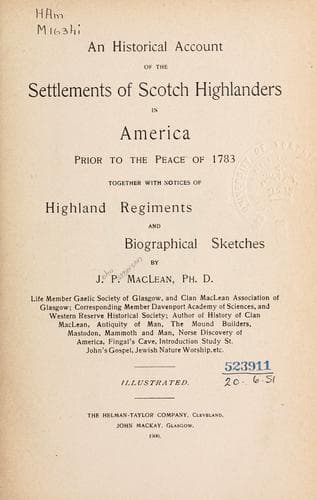
An Historical Account of the Settlements of Scotch Highlanders in AmericaMacLean, J. P. (John Patterson)
History
An Historical Account of the Settlements of Scotch Highlanders in America
MacLean, J. P. (John Patterson)
Scots -- America; Scots -- United States
Oglethorpe had previously taken the precaution, lest the Highlanders
might be apprehensive of an attack by the Spaniards, Indians, or other
enemies, while their houses were in process of construction, to send
Captain James McPherson, who commanded the rangers upon the Savannah,
overland to support them. This troop arrived while Oglethorpe was yet
present. Soon after they were visited by the Indians, who were attracted
by their costume, and ever after retained an admiration for them, which
was enhanced by the Highlanders entering into their wild sports, and
joining them in the chase. In order to connect the new settlement with
direct land communication with the other colonists, Oglethorpe, in
March, directed Hugh MacKay, with a detachment of twelve rangers, to
conduct Walter Augustin, who ran a traverse line from Savannah by Fort
Argyle to Darien, in order to locate a roadway.
It was during Oglethorpe's first trip to the Highland settlement that he
encamped on Cumberland island, and on the extreme western point, which
commands the passage of boats from the southward, marked out a fort to
be called St. Andrews, and gave Captain Hugh MacKay orders to build it.
The work commenced immediately, thirty Highlanders being employed in the
labor. On March 26th Oglethorpe, visiting the place, was astonished to
find the fort in such an advanced stage of completion; the ditch was
dug, the parapet was raised with wood and earth on the land side, and
the small wood was cleared fifty yards round the fort. This seemed to be
the more extraordinary because MacKay had no engineer, nor any other
assistance in that way, except the directions originally given. Besides
it was very difficult to raise the works, the ground being a loose sand.
They were forced to lay the trees and sand alternately,--the trees
preventing the sand from falling, and the sand the wood from fire. He
returned thanks to the Highlanders and offered to take any of them back
to their settlement, but all refused so long as there was any danger
from the Spaniards, in whose vicinity they were now stationed. But two
of them, having families at Darien, he ordered along with him.
The Highlanders were not wholly engaged in military pursuits, for, to a
great extent, they were engaged in making their settlement permanent.
They engaged in the cultivation of Indian corn and potatoes; learned to
cut and saw timber, and laid out farms upon which they lived. For a
frontier settlement, constantly menaced, all was accomplished that could
be reasonably expected. In the woods they found ripe oranges and game,
such as the wild turkey, buffalo and deer, in abundance. But peace and
prosperity were not their allotted portion, for their lines were now
cast in troubled waters. The first year witnessed an appeal to arms and
a struggle with the Spaniards, which eventually resulted in a disaster
to the Highlanders. Deeds of heroism were now enacted, fully in keeping
with the tenor of the race.
Public-domain text, read in full here on John Shaqi.
Reviews
Reviews
No reviews yet
Be the first to share your thoughts on this work.
Elsewhere in the archive
Join the Discussion
Join the discussion
Sign in to leave a comment or review.
Sign InorCreate an account