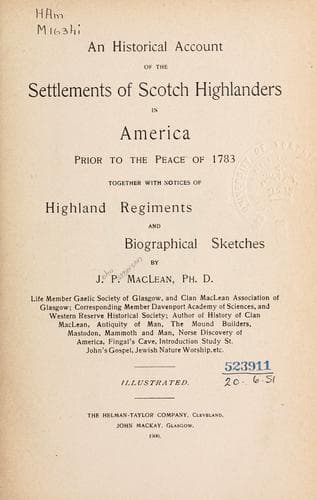
An Historical Account of the Settlements of Scotch Highlanders in AmericaMacLean, J. P. (John Patterson)
History
An Historical Account of the Settlements of Scotch Highlanders in America
MacLean, J. P. (John Patterson)
Scots -- America; Scots -- United States
The imprisoned messengers were ultimately released and sent back in a
launch with commissioners to treat with Oglethorpe. In order to make a
favorable impression on the Spaniards, the Highlanders, under Ensign
MacKay, were ordered out. June 19th, Ensign MacKay arrived on board the
man-of-war Hawk, then just off from Amelia island, with the Highlanders,
and a detachment of the independent company, in their regimentals, who
lined one side of the ship, while the Highlanders, with their claymores,
targets, plaids, etc., did the same on the other side. The commissioners
were very handsomely entertained on board the war vessel, and after
dinner messages in writing were exchanged. While this hilarity and peace
protestations were being indulged, an Indian brought the news that forty
Spaniards and some Indians had fallen upon a party of the Creek nation
who, then depending upon the general peace between the Indians, Spanish
and English, without suspicion, and consequently without guard, were
surrounded and surprised, several killed and others taken, two of whom,
being boys, were murdered by dashing out their brains.
To the people of New Iverness the year 1737 does not appear to have been
a propitious one. Pioneers were compelled to endure hardships of which
they had little dreamed, and the Highland settlement was no exception to
the rule. The record preserved for this year is exceedingly meagre and
consists almost wholly in the sworn statement of Alexander Monroe, who
deserted the colony in 1740. In the latter year he deposed that at
Darien, where he arrived in 1736 with his wife and child, he had
cleared, fenced in and planted five acres of land, built a good house in
the town, and made other improvements, such as gardening, etc.; that he
was never able to support his family by cultivation, though he planted
the said five acres three years and had good crops, and that he never
heard of any white man being able to gain a living by planting; that in
1737 the people were reduced to such distress for want of provisions,
having neither corn, peas, rice, potatoes, nor bread-kind of any sort,
nor fish, nor flesh of any kind in store; that they were forced to go in
a body, with John Mohr Macintosh at the head, to Frederica and there
make a demand on the Trust's agent for a supply; that they were relieved
by Captain Gascoigne of the Hawk, who spared them two barrels of flour,
and one barrel of beef; and further, he launches an indictment against
John Mohr Macintosh, who had charge of the Trust's store at Darien, for
giving the better class of food to his own hogs while the people were
forced to take that which was rotten.[81]
Public-domain text, read in full here on John Shaqi.
Reviews
Reviews
No reviews yet
Be the first to share your thoughts on this work.
Elsewhere in the archive
Join the Discussion
Join the discussion
Sign in to leave a comment or review.
Sign InorCreate an account