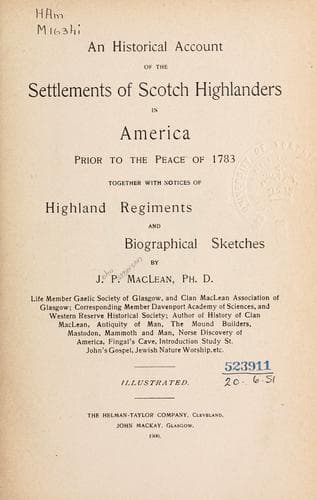
An Historical Account of the Settlements of Scotch Highlanders in AmericaMacLean, J. P. (John Patterson)
History
An Historical Account of the Settlements of Scotch Highlanders in America
MacLean, J. P. (John Patterson)
Scots -- America; Scots -- United States
While this statement of Monroe may possibly be true in the main, and
that there was actual suffering, yet it must be borne in mind that the
Highlanders were there living in a changed condition. The labor,
climate, soil, products, etc., were all new to them, and to the changed
circumstances the time had been too short for them to adapt themselves;
nor is it probable that five acres were enough for their subsistence.
The feeding of cattle, which was soon after adopted, would give them a
larger field of industry.
Nor was this all. Inevitable war fell upon the people; for we learn that
the troop of Highland rangers, under Captain MacKay, held Fort St.
Andrews "with thirty men, when the Spaniards attempted the invasion of
this Province with a great number of men in the year 1737."[82] Drawing
the men away from the settlement would necessarily cause more or less
suffering and disarrangement of affairs.
The record for the year 1738 is more extensive, although somewhat
contradictory, and exhibits a strong element of dissention. Oglethorpe
admitted the difficulties under which the people labored, ascribing them
to the Spanish alarms, but reports that John Mohr Macintosh, pursuant to
orders from the Trust, had disposed of a part of the servants to the
freeholders of Darien, which encouragement had enabled the settlement to
continue.
"The women were a dead charge to the Trust, excepting a few who mended
the Cloaths, dressed the Victuals and washed the Linnen of the Trustees
Men Servants. Some of the Soldiers who were Highlanders desiring to
marry Women, I gave them leave upon their discharging the Trustees from
all future Charges arising from them."[83]
The difficulties appear also to have arisen from the fact that the
freeholders were either unable or else unwilling--which is the more
likely--to perform manual labor. They labored under the want of a
sufficient number of servants until they had procured some who had been
indentured to the Trust for passage from Scotland.
The Reverend John MacLeod, who abandoned the colony in 1741, made oath
that in the year 1738 they found by experience that the produce from the
land did not answer the expense of time and labor, and the voice of the
people of Darien was to abandon their improvements, and settle to the
northward, where they could be free from the restraints which rendered
incapable of subsisting themselves and families.[84] The declaration of
Alexander Monroe is still more explicit:
Public-domain text, read in full here on John Shaqi.
Reviews
Reviews
No reviews yet
Be the first to share your thoughts on this work.
Elsewhere in the archive
Join the Discussion
Join the discussion
Sign in to leave a comment or review.
Sign InorCreate an account