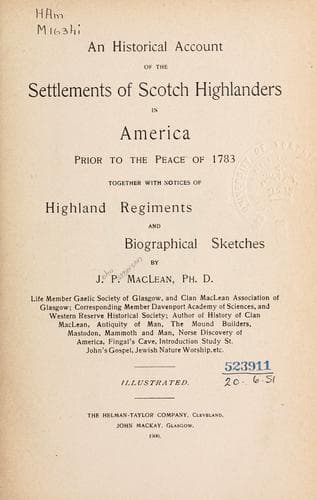
An Historical Account of the Settlements of Scotch Highlanders in AmericaMacLean, J. P. (John Patterson)
History
An Historical Account of the Settlements of Scotch Highlanders in America
MacLean, J. P. (John Patterson)
Scots -- America; Scots -- United States
The conduct of the eldest son of John Mohr MacIntosh is worthy of
mention. He was named after his grand uncle, the celebrated Old Borlum
(General William MacIntosh), who commanded a division of the Highlanders
in the Rising of 1715. William was not quite fourteen years of age when
his father left Darien for Florida. He wished to accompany the army, but
his father refused. Determined not to be thwarted in his purpose, he
overtook the army at Barrington. He was sent back the next day under an
armed guard. Taking a small boat, he ferried up to Clarke's Bluff, on
the south side of the Alatamaha, intending to keep in the rear until the
troops had crossed the St. Mary's river. He soon fell in with seven
Indians, who knew him, for Darien had become a great rendezvous for
them, and were greatly attached to the Highlanders, partly on account of
their wild manners, their manly sports and their costume, somewhat
resembling their own. They caressed the boy, and heartily entered into
his views. They followed the advancing troops and informed him of all
that transpired in his father's camp, yet carefully concealing his
presence among them until after the passage of the St. Mary's, where,
with much triumph, led him to his father and said "that he was a young
warrior and would fight; that the Great Spirit would watch over his
life, for he loved young warriors." He followed his father until he saw
him fall at Fort Moosa, covered with wounds, which so transfixed him
with horror, that he was not aroused to action until a Spanish officer
laid hold of his plaid. Light and as elastic as a steel bow, he slipped
from under his grasp, and made his escape with the wreck of the corps.
Those who escaped the massacre went over in a boat to Point Quartel.
Some of the Chickasaw Indians, who also had escaped, met a Spaniard, cut
off his head and presented it to Oglethorpe. With abhorence he rejected
it, calling them barbarian dogs and bidding them begone. As might be
expected, the Chickasaws were offended and deserted him. A party of
Creeks brought four Spanish prisoners to Oglethorpe, who informed him
that St. Augustine had been reinforced by seven hundred men and a large
supply of provisions. The second day after the Fort Moosa affair, the
Carolina[90] regiment deserted, the colonel leading the rout; nor did he
arrest his flight until darkness overtook him, thirty miles from St.
Augustine. Other circumstances operating against him, Oglethorpe
commenced his retreat from Florida and reached Frederica July 10, 1740.
Public-domain text, read in full here on John Shaqi.
Reviews
Reviews
No reviews yet
Be the first to share your thoughts on this work.
Elsewhere in the archive
Join the Discussion
Join the discussion
Sign in to leave a comment or review.
Sign InorCreate an account