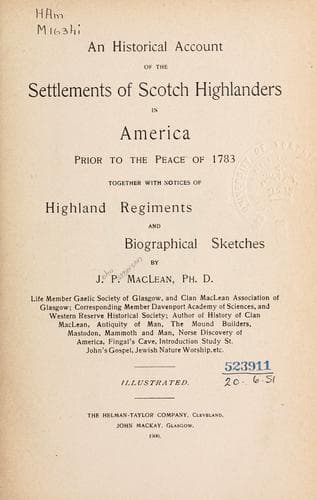
An Historical Account of the Settlements of Scotch Highlanders in AmericaMacLean, J. P. (John Patterson)
History
An Historical Account of the Settlements of Scotch Highlanders in America
MacLean, J. P. (John Patterson)
Scots -- America; Scots -- United States
The inhabitants of Darien continued to live in huts that were tight and
warm. Prior to 1740 they had been very industrious in planting, besides
being largely engaged in driving cattle for the regiment; but having
engaged in the invasion of Florida, little could be done at home, where
their families remained. One writer[91] declared that "the people live
very comfortably, with great unanimity. I know of no other settlement in
this colony more desirable, except Ebenezer." The settlement was greatly
decimated on account of the number killed and taken prisoners at Fort
Moosa. This gave great discontent on the part of those who already felt
aggrieved against the Trust.
The discontent among many of the colonists, some of whom were
influential, again broke out in 1741, some of whom went to Savannah,
October 7th, to consider the best method of presenting their grievances.
They resolved to send an agent to England to represent their case to
the proper authorities, "in order to the effectual settling and
establishing of the said province, and to remove all those grievances
and hardships we now labor under." The person selected as agent was
Thomas Stevens, the son of the president of Georgia, who had resided
there about four years, and who, it was thought, from his connection
with the president, would give great weight to the proceedings. Mr.
Stevens sailed for England on March 26, 1742, presented his petition to
parliament, which was considered together with the answer of the
Trustees; which resulted in Mr. Stevens being brought to the bar of the
House of Commons, and upon his knees, before the assembled counsellors
of Great Britain, was reprimanded for his conduct, and then discharged,
on paying his fees.
A list of the people who signed the petition and counter petitions
affords a good criterion of the class represented at Darien, living
there before and after the battle of Moosa. Among the complainants may
be found the names of:
James Campbell, Thomas Fraser, Patrick Grahame, John Grahame, John
McDonald, Peter McKay, Benjamin McIntosh, John McIntosh, Daniel
McKay, Farquhar McGuilvery, Daniel McDonald, Rev. John McLeod,
Alexander Monro, John McIntire, Owen McLeod, Alexander Rose, Donald
Stewart.
It is not certain that all the above were residents of Darien. Among
those who signed the petition in favor of the Trust, and denominated the
body of the people, and distinctly stated to be living at Darien, are
the names of:
John Mackintosh Moore, John Mackintosh Lynvilge, Ronald McDonald,
Hugh Morrison, John McDonald, John Maclean, John Mackintosh, son of
L., John Mackintosh Bain, John McKay, Daniel Clark, first, Alexander
Clarke, Donald Clark, third, Joseph Burges, Donald Clark, second,
Archibald McBain, Alexander Munro, William Munro, John Cuthbert.
Public-domain text, read in full here on John Shaqi.
Reviews
Reviews
No reviews yet
Be the first to share your thoughts on this work.
Elsewhere in the archive
Join the Discussion
Join the discussion
Sign in to leave a comment or review.
Sign InorCreate an account