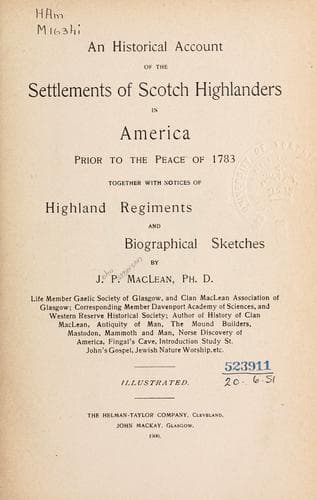
An Historical Account of the Settlements of Scotch Highlanders in AmericaMacLean, J. P. (John Patterson)
History
An Historical Account of the Settlements of Scotch Highlanders in America
MacLean, J. P. (John Patterson)
Scots -- America; Scots -- United States
alarmed on the appearance of three vessels off the bar that they
immediately set fire to the fort and precipitately embarked their
troops, abandoning in their hurry and confusion, several cannon, a
quantity of military stores, and even leaving unburied some of the men
who had just died of their wounds.
The massacre of Fort Moosa was more than doubly avenged, and that on the
same Spanish regiment that was then victorious. On the present occasion
they had set out from their camp with the determination to show no
quarter. In the action William MacIntosh, now sixteen years of age, was
conspicuous. No shout rose higher, and no sword waved quicker than his
on that day. The tract of land which surrounded the field of action was
afterwards granted to him.
A brief sketch of Ensign John Stuart will not be out of place in this
record and connection. During the Spanish invasion he was stationed at
Fort William, and there gained an honorable reputation in holding it
against the enemy. Afterwards he became the celebrated Captain Stuart
and father of Sir John Stuart, the victor over General Ranier, at the
battle of Maida, in Calabria. In 1757 Captain Stuart was taken prisoner
at Fort Loudon, in the Cherokee country, and whose life was saved by his
friend, Attakullakulla. This ancient chief had remembered Captain Stuart
when he was a young Highland officer under General Oglethorpe, although
years had rolled away. The Indians were now filled with revenge at the
treachery of Governor Littleton, of Carolina, on account of the
imprisonment and death of the chiefs of twenty towns; yet no actions of
others could extinguish, in this generous and high-minded man, the
friendship of other years. The dangers of that day, the thousand wiles
and accidents Captain Stuart escaped from, made him renowned among the
Indians, and centered on him the affections and confidence of the
southern tribes. It was the same Colonel John Stuart, of the
Revolutionary War, who, from Pensacola, directed at will the movements
of the Cherokees, Creeks, Chickasaws and Choctaws, against all, save
Georgia. That state suffered but little from Indian aggression during
the War for Independence. Nor was that feeling extinct among the Creeks
for a period of fifty years, or until they believed that the people of
Oglethorpe had passed away.
Public-domain text, read in full here on John Shaqi.
Reviews
Reviews
No reviews yet
Be the first to share your thoughts on this work.
Elsewhere in the archive
Join the Discussion
Join the discussion
Sign in to leave a comment or review.
Sign InorCreate an account