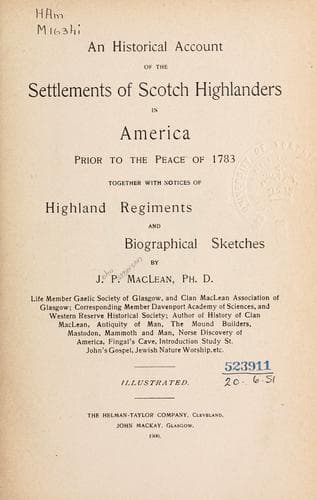
An Historical Account of the Settlements of Scotch Highlanders in AmericaMacLean, J. P. (John Patterson)
History
An Historical Account of the Settlements of Scotch Highlanders in America
MacLean, J. P. (John Patterson)
Scots -- America; Scots -- United States
Spanish forces overwhelmed the colonists by their superior numbers, when
the veteran troops became seized with a panic. They made a precipitate
retreat, the Highlanders following reluctantly in the rear. After
passing through a defile, Lieutenant MacKay communicated to his friend,
Lieutenant Southerland, who commanded the rear guard, composed also of
Highlanders, the feelings of his corps, and agreeing to drop behind as
soon as the whole had passed the defile. They returned through the brush
and took post at the two points of the crescent in the road. Four
Indians remained with them. Scarcely had they concealed themselves in
the woods, when the Spanish grenadier regiment, the _elite_ of their
troops, advanced into the defile, where, seeing the footprints of the
rapid retreat of the broken troops, and observing their right was
covered by an open morass, and their left, as they supposed, by an
impracticable wall of brushwood, and a border of dry white sand, they
stacked their arms and sat down to partake of refreshments, believing
that the contest for the day was over. Southerland and MacKay, who, from
their hiding places, had anxiously watched their movements, now from
either end of the line raised the Highland cap upon a sword, the signal
for the work of death to begin. Immediately the Highlanders poured in
upon the unsuspecting enemy a well delivered and most deadly fire.
Volley succeeded volley, and the sand was soon strewed with the dead and
the dying. Terror and dismay seized the Spaniards, and making no
resistance attempted to fly along the marsh. A few of their officers
attempted, though in vain, to re-form their broken ranks; discipline was
gone; orders were unheeded; safety alone was sought; and, when, with a
Highland shout of triumph, the hidden foe burst among them with levelled
musket and flashing claymore, the panic stricken Spaniards fled in
every direction; some to the marsh, where they mired and were taken;
others along the defile, where they were met by the claymore, and still
others into the thicket, where they became entangled and perished; and a
few succeeded in escaping to their camp. Barba was taken, though
mortally wounded. Among the killed were a captain, lieutenant, two
sergeants, two drummers and one hundred and sixty privates, and a
captain and nineteen men taken prisoners. This feat of arms was as
brilliant as it was successful. Oglethorpe, with the two platoons, did
not reach the scene of action, since called the "Bloody Marsh," until
the victory was won. To show his sense of the services rendered, he
promoted the brave young officers who had gained it on the very field of
their valor. But he rested only for a few minutes, waiting for the
marines and the reserve of the regiment to come up; and then pursued the
retreating enemy to within a mile and a half of their camp. During the
night the foe retreated within the ruins of the fort, and under the
protection of their cannon. A few days later the Spaniards became so
Public-domain text, read in full here on John Shaqi.
Reviews
Reviews
No reviews yet
Be the first to share your thoughts on this work.
Elsewhere in the archive
Join the Discussion
Join the discussion
Sign in to leave a comment or review.
Sign InorCreate an account