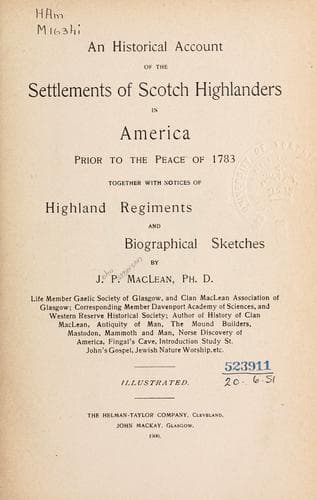
An Historical Account of the Settlements of Scotch Highlanders in AmericaMacLean, J. P. (John Patterson)
History
An Historical Account of the Settlements of Scotch Highlanders in America
MacLean, J. P. (John Patterson)
Scots -- America; Scots -- United States
Before the arrival of the settlers, a desperado, named Rogers, had taken
possession of a part of the lands on the Batten Kill. He warned the
people off, making various threats; but the Highlanders knowing their
titles were perfect, disregarded the menace, and set about industriously
clearing up their lands and erecting their houses. One day, when
Archibald Livingston was away, his wife was forcibly carried off by
Rogers, and set down outside the limits of the claim, who also proceeded
to remove the furniture from the premises. He was arrested by Roger
Reid, the constable, and brought before Alexander McNaughton, the
justice, which constituted the first civil process ever served in that
county. Rogers did not submit peaceably to be taken, but defended
himself with a gun, which Joseph McCracken seized, and in his endeavor
to wrest it from the hands of the ruffian, he burst the buttons from off
the waist-bands of his pantaloons, which, as he did not wear suspenders,
slipped over his feet. The little son of Rogers, fully taking in the
situation, ran up and bit McCracken, which, however, did not cause him
to desist from his purpose. Rogers was conveyed to Albany, after which
all trace of him has been lost.
The township of Argyle, embracing what is now both Argyle and Fort
Edward, was organized in 1771. The record of the first meeting bears
date April 2, 1771, and was called for the purpose of regulating laws
and choosing officers. It was called by virtue of the grant in the
Argyle patent. The officers elected were: supervisor, Duncan Campbell,
who continued until 1781, and was then succeeded by Roger Reid; town
clerk, Archibald Brown, succeeded in 1775 by Edward Patterson, who, in
turn, was succeeded in 1778 by John McNeil, and he by Duncan Gilchrist,
in 1780; collector, Roger Reid, succeeded in 1778 by Duncan McArthur,
and the latter in 1781 by Alexander Gilchrist; assessors, Archibald
Campbell and Neal Shaw; constables, John Offery, John McNiel;
poor-masters, James Gilles, Archibald McNiel; road-masters, Duncan
Lindsey, Archibald Campbell; fence viewers, Duncan McArthur, John
Gilchrist.
The following extracts from township records are not without interest:
1772.--"All men from sixteen to sixty years old to work on the roads
this year. Fences must be four feet and a half high."
1776.--"Duncan Reid is to be constable for the south part of the
patent and Alexander Gillis for the north part; George Kilmore and
James Beatty for masters. John Johnson was chosen a justice of the
peace."
1781.--"Alexander McDougall and Duncan Lindsey were elected tithing
men."
Public-domain text, read in full here on John Shaqi.
Reviews
Reviews
No reviews yet
Be the first to share your thoughts on this work.
Elsewhere in the archive
Join the Discussion
Join the discussion
Sign in to leave a comment or review.
Sign InorCreate an account