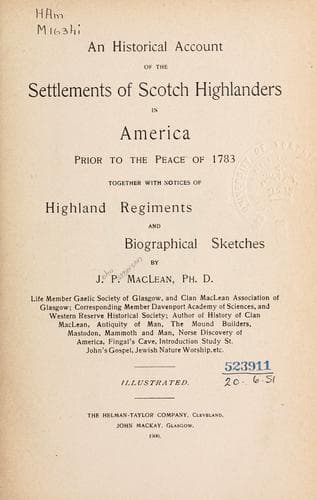
An Historical Account of the Settlements of Scotch Highlanders in AmericaMacLean, J. P. (John Patterson)
History
An Historical Account of the Settlements of Scotch Highlanders in America
MacLean, J. P. (John Patterson)
Scots -- America; Scots -- United States
In order to make the laws more efficient, on March 12, 1772, the county
of Charlotte was struck off from Albany, which was the actual beginning
of the present county of Washington. As Charlotte county had been named
for the consort of George III. and as his troops had devastated it
during the Revolution, the title was not an agreeable one, so the state
legislature on April 2, 1784, changed it to Washington, thus giving it
the most honored appellation known in the annals of American history.
For several years after 1764 the colony on the east, and in what is now
Hebron township, was augmented by a number of discharged Highland
soldiers, mostly of the 77th Regiment, who settled on both sides of the
line of the township. It is a noticeable fact that in every case these
settlers were Scotch Highlanders. They had in all probability been
attracted to this spot partly by the settlement of the colony of Captain
Lachlan Campbell, and partly by that of the Scotch-Irish at New Perth
(Salem), which has been noted already in its proper connection. These
additional settlers took up their claims, owing to a proclamation made
by the king, in October, 1763, offering land in America, without fees,
to all such officers and soldiers who had served on that continent, and
who desired to establish their homes there.
Nothing shows more clearly than this proclamation the lofty position of
an officer in the British service at that time as compared with a
private. A field officer received four thousand acres; a captain three
thousand; a lieutenant, or other subaltern commissioned officer, two
thousand; a non-commissioned officer, whether sergeant or corporal,
dropped to two hundred acres, while the poor private was put off with
fifty acres. Fifty acres of wild land, on the hill-sides of Washington
County, was not an extravagant reward for seven years' service amidst
all the dangers and horrors of French and Indian warfare.
Many of these grants were sold by the soldiers to their countrymen.
Their method of exchange was very simple. The corporal and private would
meet by the roadside, or at a neighboring ale-house, and after greeting
each other, the American land would immediately be the subject for
barter. The private, who may be called Sandy, knew his fifty acres was
not worth the sea-voyage, while Corporal Donald, having already two
hundred, might find it profitable to emigrate, provided he could add
other tracts. After the preliminaries and the haggling had been gone
through with, Donald would draw out his long leather purse and count
down the amount, saying:
"There, mon; there's your siller."
Public-domain text, read in full here on John Shaqi.
Reviews
Reviews
No reviews yet
Be the first to share your thoughts on this work.
Elsewhere in the archive
Join the Discussion
Join the discussion
Sign in to leave a comment or review.
Sign InorCreate an account