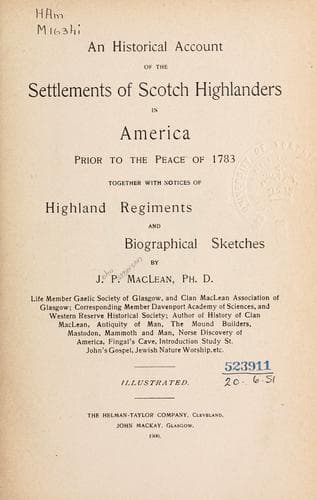
An Historical Account of the Settlements of Scotch Highlanders in AmericaMacLean, J. P. (John Patterson)
History
An Historical Account of the Settlements of Scotch Highlanders in America
MacLean, J. P. (John Patterson)
Scots -- America; Scots -- United States
Sir William Johnson thoroughly gained the good graces of the Iroquois
Indians, and by the part he took against the French at Crown Point and
Lake George, in 1755, added to his reputation at home and abroad. For
his services to the Crown he was made a baronet and voted L5000 by the
British parliament, besides being paid L600 per annum as Indian agent,
which he retained until his death in 1774. He also received a grant of
one hundred thousand acres of land north of the Mohawk. In 1743 he built
Fort Johnson, a stone dwelling, on the same side of the river, in what
is now Montgomery county. A few miles farther north, in 1764, he built
Johnson Hall, a wooden structure, and there entertained his Indian bands
and white tenants, with rude magnificence, surrounded by his mistresses,
both white and red. He had dreams of feudal power, and set about to
realize it. The land granted to him by the king, he had previously
secured from the Mohawks, over whom he had gained an influence greater
than that ever possessed heretofore or since by a white man over an
Indian tribe. The tract of land thus gained was long known as
"Kingsland," or the "Royal Grant." The king had bound Sir William to him
by a feudal tenure of a yearly rental of two shillings and six pence for
each and every one hundred acres. In the same manner Sir William bound
to himself his tenants to whom he granted leases. In order to secure the
greatest obedience he deemed it necessary to secure such tenants as
differed from the people near him in manners, language, and religion,
and that class trained to whom the strictest personal dependence was
perfectly familiar. In all this he was highly favored. He turned his
eyes to the Highlands of Scotland, and without trouble, owing to the
dissatisfied condition of the people and their desire to emigrate, he
secured as many colonists as he desired, all of whom were of the Roman
Catholic faith. The agents having secured the requisite number,
embarked, during the month of August, 1773, for America.
A journal of the period states that "three gentlemen of the name of
Macdonell, with their families, and 400 Highlanders from the counties
(!) of Glengarry, Glenmorison, Urquhart, and Strathglass lately embarked
for America, having obtained a grant of land in Albany,"[101]
Public-domain text, read in full here on John Shaqi.
Reviews
Reviews
No reviews yet
Be the first to share your thoughts on this work.
Elsewhere in the archive
Join the Discussion
Join the discussion
Sign in to leave a comment or review.
Sign InorCreate an account