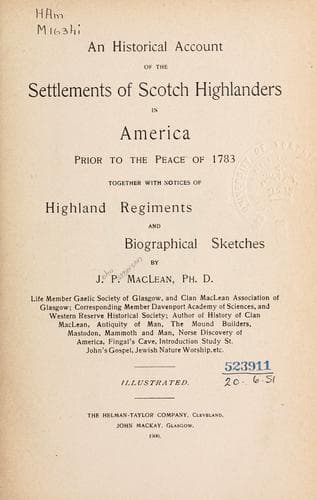
An Historical Account of the Settlements of Scotch Highlanders in AmericaMacLean, J. P. (John Patterson)
History
An Historical Account of the Settlements of Scotch Highlanders in America
MacLean, J. P. (John Patterson)
Scots -- America; Scots -- United States
This extract appears to have been copied from the _Courant_ of August
28th, which stated they had "lately embarked for America." This would
place their arrival on the Mohawk some time during the latter part of
the following September, or first of October. The three gentlemen above
referred to were Macdonell of Aberchalder, Leek, and Collachie, and also
another, Macdonell of Scotas. Their fortunes had been shattered in "the
45," and in order to mend them were willing to settle in America. They
made their homes in what was then Tryon county, about thirty miles from
Albany, then called Kingsborough, where now is the thriving town of
Gloversville. To certain families tracts were allotted varying from one
hundred to five hundred acres, all subjected to the feudal system.
Having reached the places assigned them the Highlanders first felled the
trees and made their rude huts of logs. Then the forest was cleared and
the crops planted amid the stumps. The country was rough, but the people
did not murmur. Their wants were few and simple. The grain they reaped
was carried on horseback along Indian trails to the landlord's mills.
Their women became accustomed to severe outdoor employment, but they
possessed an indomitable spirit, and bore their hardships bravely, as
became their race. The quiet life of the people promised to become
permanent. They became deeply attached to the interests of Sir William
Johnson, who, by consummate tact soon gained a mastery over them. He
would have them assemble at Johnson Hall that they might make merry;
encourage them in Highland games, and invite them to Indian councils.
Their methods of farming were improved under his supervision; superior
breeds of stock sought for, and fruit trees planted. But Sir William, in
reality, was not with them long; for, in the autumn of 1773, he visited
England, returning in the succeeding spring, and dying suddenly at
Johnson Hall on June 24th, following.
Troubles were rising beneath all the peaceful circumstances enjoyed by
the Highlanders, destined to become severe and oppressive under the
attitude of Johnson's son and son-in-law who were men of far less
ability and tact than their father. The spirit of democracy penetrated
the valley of the Mohawk, and open threats of opposition began to be
heard. The Acts of the Albany Congress of 1774 opened the eyes of the
people to the possibilities of strength by united efforts. Just as the
spirit of independence reached bold utterance Sir William died. He was
succeeded in his title, and a part of his estates by his son John. The
dreams of Sir William vanished, and his plans failed in the hands of his
weak, arrogant, degenerate son. Sir John hesitated, temporized, broke
his parole, fled to Canada, returned to ravage the lands of his
countrymen, and ended by being driven across the border.
Public-domain text, read in full here on John Shaqi.
Reviews
Reviews
No reviews yet
Be the first to share your thoughts on this work.
Elsewhere in the archive
Join the Discussion
Join the discussion
Sign in to leave a comment or review.
Sign InorCreate an account